The Orlando Pride began the 2024 NWSL season with two wins and three draws from their opening five games. Competitive in every game, the most important element of their play so far has been their defence. Before we get onto what they do well on the defensive end tactically, let’s take a quick look through other components—technical, psychological and physical—that may also have impacted their strong start. All quotes are courtesy of interviews on the Orlando Pride YouTube channel, unless otherwise stated.
Orlando’s defence: Some backstory
Technical
Seb Hines became Orlando’s head coach in 2022, and since then the team has developed into a more solid defensive side. This season, however, they are a much better side in possession than they have been for a while. There is an increased ability to move up field more patiently with the ball under their control. This has a lot to do with the changing profiles of Orlando’s midfielders.
Brazil international Angelina and 2015 World Cup-winner Morgan Gautrat arrived in the off-season and have become the preferred central midfield pairing, bringing greater composure, touch and passing quality to the midfield. Forward Julie Doyle commented on the impact of this change of profiles, saying: “We used to kind of just skip the midfield. It would go from defence to forwards and we [the forwards] would have to just run it down, but now we can link up with them [the midfielders], we can take the air out of the game and have control.”
Subsequently, Orlando’s average possession percentage has gone up. Last year, they had the lowest share in the league, 46.4%. This year so far, they average 51.8% possession. At the moment, Orlando have less defending to do. This perhaps helps them to save their legs, or as Doyle puts it, “take the air out of the game”, and conserve some energy for those spells where they do have to defend.
Psychological
Orlando may not be a classical high pressing side, like Gotham FC, who are always trying to win the ball deep in opposition territory. However, when they go, they really go. Their recent 1-0 win over the San Diego Wave was the best example, showing a high level of aggression to go and win the ball. A lot of NWSL teams are organised in pressing, but few apply the sort of aggression in the tackle that Orlando displayed in that first hour against San Diego.
There is also a strong work rate, starting from the front players. Orlando defend in a 4-4-2 formation, but the front two come back to help the midfielders and double up on opponents, as we will see (with video) in due course. This is what head coaches may refer to as culture or mindset. And who better to lead than Marta, who at 38 years old, still helps teammates defensively. This is setting standards by example: Players see what is required to make the team, and copy it. If a six-time FIFA World Player of the Year attacker is working hard defensively at this late stage of her career, everyone else must follow.
Physical
If we extract Orlando’s points per game from the 18 games after a terrible start in 2023 and extrapolate it to a full season, they would have finished top and won the NWSL Shield. This has become a rallying call going into the 2024 campaign, with a focus on being sharp from the get-go and aiming to make the playoffs for just the second time in club history. “The message is we need to be fit and ready for March 16 against Louisville,” Hines said in a pre-season press conference. “We now know how important the start of the season can be.”
Early this season, Orlando have shown an ability to implement their pressing game throughout the majority of matches. Not only do they possess speed throughout most of the line-up, but they have the fitness to sprint and close down, time after time. This isn’t just about suffocating teams in their own heat and humidity. Kylie Strom was sent off 62 minutes into their opener away to Louisville, but Orlando ‘won’ the remainder of that game 1-0. They were able to retain their defensive principles, with one less player, for half an hour, keep applying their form of pressure, and go from losing to earning a point.
A brief segue: Some intriguing defensive stats
Over the last two years, Orlando have gradually developed in every aspect to the point that they now look like a well-rounded team. Still, their defence is the element I want to drill down on, because that’s what stands out to me. And it also stands out in numbers.
During Hines’ first full season, Orlando kept seven clean sheets. That means they didn’t concede a goal in 31.8% of their matches, which is their highest ‘clean sheet percentage’ in club history. Seven clean sheets is also the highest total that Orlando have kept in one season, including the seasons where there were more games to play. Below is the overall record.
Clean sheet totals + percentage of games a clean sheet was kept, by year:
- 2016: four in 20 games, 20.0%
- 2017: four in 24 games, 16.7%
- 2018: five in 24 games, 20.8%
- 2019: one in 24 games, 4.2%
- 2021: three in 24 games, 12.5%
- 2022: four in 22 games, 18.2%
- 2023: seven in 22 games, 31.8%
On to this season, and—according to FBref data—so far the Orlando Pride has the second-best xGA (expected goals against) in the NWSL. They also lie second in terms of lowest number of progressive passes conceded per 90 minutes, and joint-third for lowest number of passes into their own defensive third per 90. It’s early days to read too much into this sort of data, but it correlates with what I’m seeing, which is a solid team that takes great pride in being hard to play against.
Defensive tactics
Time for some Xs and Os! I’ve selected some highlights from various games in the 2024 season that showcase the key themes I consider part and parcel of what makes Orlando a solid defensive outfit.
The front two: Front marking and helping back
Orlando typically defend in a 4-4-2 formation, with the attacking midfielder joining the striker up top. The front two are responsible for reducing the opponent’s passing angles into central midfield, forcing them long into contested ball situations, or sideways or backwards where Orlando’s pressing can commence.
The front two do not usually stand behind their opposition. Instead, they mark from in front, or sometimes to the side. They aren’t trying to tempt the opponent into risky passes where they can tackle. Rather, by positioning themselves somewhere between the opponent’s centre-backs and central midfielders, they want to stop the opponent from being able to access their midfielders altogether. Every now and then, the opponent may be brave and try to play past them, and they can intercept the ball cleanly and attack.
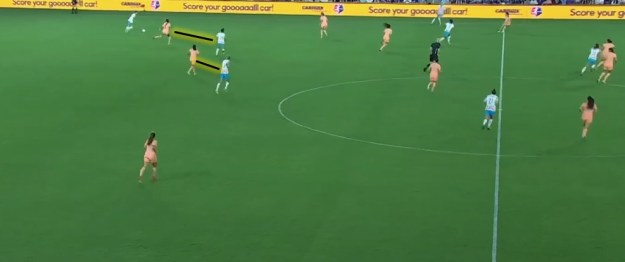
Orlando’s front two marking the opposition from in front, blocking passes into central midfield.
Relatively longer-distance back-passes to the goalkeeper are invitations for the front two to press up. Using the time it takes for the ball to go from one player to another, Orlando try to get closer and rush their opposition. These opportunities don’t always exist, of course. Teams like Angel City and San Diego build-up with their goalkeeper in an advanced position, so back-passes are shorter and offer less time to press up. Then there are the Chicago Red Stars, who go long more often and therefore don’t ‘trigger’ any kind of pressing in those moments.
Still, there are other ways for Orlando to start pressing. Their front two does an important job in creating those opportunities with their defensive positions, staying together as a unit and often getting in front of the opponent’s holding midfielders, forcing the opposition sideways or wide and into other pressing triggers, which we will get to shortly.
Finally, if the opponent does find its way into central midfield, Orlando’s front two will come back to help apply pressure in this area, at times doubling up with their midfield teammates to press the ball-player from multiple directions.
The wingers: Pressing, decision-making
Orlando’s wingers can also instigate pressing in a couple of different situations. These moments are rarer and dependent on the decision-making of the individuals. Julie Doyle and Angelina have created a few turnovers with their reading of the situation and speed to close down.
The positioning of Orlando’s front two can force the opponent to pass sideways along their back line. In these situations, if the distance between opponents is a longer one, Orlando’s ball-side winger may take the time the pass takes to step up and close down the receiver.
Alternatively, if an opponent receives the ball in a position away from Orlando’s front two and central midfielders, the wingers may step in and close them down, especially if they are facing infield and unable to see the pressure coming.
Orlando’s wingers often take up intelligent ‘halfway’ positions, between multiple opponents. That means they can potentially press a midfielder inside, press up on a centre-back, or press out on a full-back, depending on where the ball goes.
Caging opponents on the touchline
The work of Orlando’s front two is one example of something we see in lots of teams—trying to reduce options and make the opponent’s build-up more predictable so teammates can commit to pressing in those areas the ball is ‘predicted’ to go. Not every team does it the same way. Another example is when we see a striker splitting the opponent’s centre-backs. By taking away the sideways ball, they can cut the field in half and allow teammates on the ball-side to commit, getting tighter to their opponents (see England at Euro 2022).
Orlando’s front two are primarily trying to block passes into central midfield, so the opponent has to go elsewhere: often into the wide areas. When this happens, Orlando’s wingers will apply pressure on the receiving player. If the ball goes down the line, the wingers will then take up a front marking position on the opponent they just closed down and help their full-backs, doubling up on the opponent. Orlando’s ball-side forward and/or midfielder also come across to take away the pass inside and ‘cage’ the opposition on the touchline.
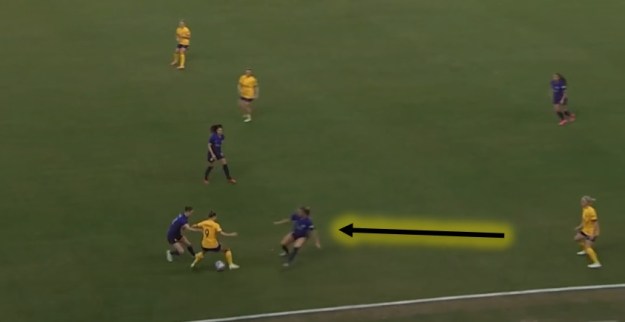
Orlando winger (Doyle) doubles up on opponent with the full-back (Martinez). The ball-side midfielder (Angelina) covers the pass inside.
This is what some coaches term ‘pressing traps’: Encouraging the opposition to pass into an area where you can press them from different directions, out-number and win the ball. Orlando’s touchline cage consistently results either in winning the ball or slowing the opposition down. It works not just because of its organisation, but the aggression of the players involved.
After the away win over the Utah Royals, Kylie Strom highlighted the importance of the full-backs, Brianna Martinez and Kerry Abello, two quick players who aren’t afraid to be physical with their direct opponents, saying: “We rely a lot on our full-backs to win their individual battles.”
The centre-backs: Aggressive marking & speed
If we want to see an example of the aggression and desire to win ball in this Orlando team, perhaps the best place to look is at their centre-backs. Emily Sams and Kylie Strom have been the usual starters this season. Sams is known for her tight marking, having largely nullified Sophia Smith during Orlando’s 3-1 win over Portland in June 2023. Strom normally plays at left full-back, but has adapted very well to the centre-back position in 2024.
Sometimes Orlando’s defensive approach will force the opposition to be more direct, and go straight to their frontline. That can be a ball over the top into space, where Sams and Strom have the requisite speed to recover the ball or at least keep up with their opponent and defend the channel. Alternatively, it could be a ball into the feet of a striker. In these situations, Sams and Strom all but trample over their opposition, stopping them from being able to turn and play forward, and often stealing the ball.
This aggressive marking style is also relevant to Orlando’s counter-pressing, just after they lose the ball. Sams and Strom are proactive, getting tight when the opportunity is there and making sure that, if their opponent receives, they have no space to turn and progress the counter-attack.
Counter-pressing
When Orlando lose the ball, there is a collective effort to try and nullify the opponent’s counter-attack and regain possession quickly if possible. This is less a structural thing and more about the mentality of the team. They are switched on and ready to press in these moments. If one player goes but others don’t follow, the counter-press will fail, so it takes a team effort and a mindset that is collectively accepted and harnessed through training. Here are some of the results.
In conclusion
Last season was the second-best in Orlando Pride history, both in terms of league position and points per game. This upturn was built primarily on defensive improvement. Unsurprisingly, given the progress made since he took charge, Seb Hines is now the second-longest serving head coach in club history in terms of games managed.
Orlando continue to develop their attacking play, and the signing of Barbra Banda should take some weight off of Adriana Leal’s shoulders. Alongside the proven quality of Banda, Adriana and Marta, there is a complementary group of players who impress with their defensive work ethic, constant running, versatility and athleticism: Julie Doyle, Ally Watt, Angelina and Summer Yates.
As a team, the Pride are less reliant on defence than before. There is now greater confidence that they can maintain possession, and Banda should add goal threat. Still, their defensive play continues to impress. It’s not simply about what they do (structure, pressing triggers and traps), but how they do it. Every member of the team involved; a desire to win the ball, not just reduce space; and a consistency to do this game after game. This speaks to the quality of work done by players and coaching staff in training.
Orlando’s unbeaten start the campaign has been impressive. In a league as competitive as the NWSL, that almost certainly won’t last. Washington Spirit are up next, a difficult away game against one of the most dangerous counter-attacking sides in the league. Nonetheless, Orlando’s strong start should give fans real hope about a playoff spot at season’s end, something the club hasn’t achieved since 2017.
Discover more from Women's Soccer Report
Subscribe to get the latest posts sent to your email.

Great content! Would love to read more!
LikeLike
Thank you! I’m aiming to write something on Orlando’s win over KC this week.
LikeLike