This will be a loose collection of my thoughts on football, including how it is played, how teams are built and managed. It’s more a ramble than anything else, calling on various conversations and experiences in scouting, coaching, playing, writing and reading about the game. While this is a women’s football site, along the way here I will take detours into men’s football, other sports, and other walks of life entirely. Hopefully it sparks an idea and is of some use, or at least some passing entertainment.
Form follows function
Ever seen a YouTube compilation of failed passing triangles? No, me neither. That’s because at the root of every single playing style under the sun is a certain functionality. It has to work. More specifically, it has to help the team towards its end goals.
A chair is for sitting on. No matter how intricate or beautiful its design; if it collapses upon impact with the human backside, it isn’t fit for purpose. With that wonderful image in mind, even the most scintillating, risk-taking and revolutionary football teams of all time were effective. Deep down, whether we want to admit it or not, we watched, admired and studied the Barcelona of Cortes and Giraldez, Putellas and Bonmati, because they were unbelievably effective. Their passing and pressing overwhelmed even the best opposition.
Achievement is not the same definition for everyone. For some clubs, finishing in a league position high enough to avoid relegation would be monumental. For others, it would be catastrophic. Either way, all teams should be built and managed with their aims firmly in mind. Form follows function.
Sometimes, football fans kid themselves into believing that the way their team plays matters more than the result. It’s amazing how malleable those principles become after a long losing streak, or a shocking defeat to a rival. Perhaps, after a long time spent achieving the same objective, we may grow tired and demand a more exciting style of play. What we really want is one of two things: improvement, or change. If you can’t improve the results, change the style, the coach, the players. But again, notice how the result element comes first.
Some Stoke City supporters might have grown tired of Tony Pulis’ methods after five straight years of Premier League safety. Now, 12 years on, the last seven spent treading water in the second division, they may feel differently about Pulis’ methodology.
It takes two to tango
Some managers have deeply held personal preferences. However, attempting to impose an abstract idea of morally “right” or “good” football onto a group of players is not only full of obvious risks, but misses the point entirely as to what “good football” is.
Football is a competitive game played by two teams. Each tries to win, with their own players; their own unique strengths and weaknesses; their own community, culture; their own history and expectations. These differences, combined with an agreed time limit, the fact of one ball, 11 players apiece and two goals at either end, create the natural aesthetics of the game.
Managers don’t need to go looking for good football. Good football is something that happens naturally, when two well-set up teams play each other. The ensuing competitive friction is where we see contrasting styles, some matching up better than others.
If anything, trying to force an approach will look just that on the pitch: forced. Players doing things that are counterintuitive or unnatural, to fulfil the manager’s own preferences as opposed to playing the game in front of them. An example: a coach can talk about the need to “break the lines”. But space on a football field only exists where the opponent isn’t. It doesn’t matter which spaces you want to exploit if the opponent covers them. It takes two to tango.
Most of the top managers and teams do not put the cart before the horse. They score regularly inside the first half-hour. They win the key battles, play the game in the opponent’s half, apply pressure until they find the opening, then go for the jugular for a second. That changes the dynamic and opens up the game. It’s a lot easier to play “exciting” football, quick one-twos, combinations and fast counters, when you’re a goal or two up against a chasing opponent compared to when you’re colliding into an obstinate defensive block at 0-0. Goals first, highlight reels later.
There are two phrases I’ve heard that have to be challenged. One is “rest with the ball”, and the other is “defend with the ball”. Both fail to account properly for the reality of opposition.
The defending team always sets the tempo, so you can only “rest with the ball” if the defending team allows you too. The intensity and aggression of the opponent’s defending directly impacts how quickly you need to move the ball. Again, two to tango. And “defend with the ball” simply doesn’t make sense. If you’re any good at attacking you will shoot, miss, score. Either way, at the end of your attack you will have to defend, this is non-negotiable.
Different is dangerous: Football’s dark forest
Every few years, a mass of football pundits and fans claim that the game has become homogeneous, samey, boring. Too many teams with too few ideas. It’s bad for the sport, they might argue. While I don’t disagree, it’s worth exploring why this narrative trend repeats.
Antonio Conte brought something different to the Premier League when he took over at Chelsea in 2016. After a bad defeat to Arsenal, he implemented a back three, something that wasn’t popular within the league at the time. Chelsea went on to win the title with 93 points, then the second-highest tally in Premier League history. But they weren’t so effective the following year, ending up on 70 points and finishing fifth, missing out on the Champions League. Conte was sacked within 14 months of winning the title.
Marcelo Bielsa completely revolutionised the way Leeds United played when he took over in 2018, and led them to a 9th-place finish in their first season back in the Premier League. By mid-February the following year, Bielsa had been sacked. Four straight losses left the team in 16th, with just three wins from 26 games. The drop-off from the year before was stark.
Sheffield United enjoyed a similar trajectory under Chris Wilder. They finished 9th in their first season back in the Premier League in 2020, with a distinctive style that opponents were not used to. The next year their play wasn’t so effective—Wilder left by mutual consent in March and Sheffield United were relegated after finishing bottom of the table.
This is football’s own version of the dark forest hypothesis. The more your team stands out, the easier you are for rivals to notice, adjust for your strengths, zone in on your weaknesses, or copycat with better players and greater financial muscle. Maybe it’s more sensible to not stand out, to instead be quietly effective, to do the basics well. And perhaps this explains why football, every now and then, gets stuck in a rut, with teams doing the same things, over and over again.
Play the opponent in front of you
When I have the time and energy, I love to play tennis. It’s the only sport I play regularly now. For a few years starting in 2017, I would play against the same opponent once every couple of weeks. Our approaches were considerably different. I would try to hit the ball as truly, as powerfully and as precisely as I could. He would run around and hit it back to me. He beat me nine times out of 10.
I had no idea what was going on. I thought my technique was better, and I was trying to win points while he was trying to survive. I felt more deserving of the victory, even though it never looked like happening. I’d smile on the outside, “good game”, and on the inside I was spitting feathers. The truth is he was playing smarter tennis, and successfully imposing his lower risk game plan on me every single time.
I’d estimate we played each other about 30 times before I realised what was happening and how to change it. What I learned was that if I hit the ball slower, and more centrally, I had a much better chance of winning points. I expended less energy in the rallies, put less pressure on myself to hit perfect winning shots, and mentally accepted that a marathon, not a sprint, was on the cards. Ironically, by attempting fewer winners, I won more points.
At first it felt uncomfortable, counterintuitive even. But suddenly I was winning more of these matches than I lost. My opponent had less pace to work with and less angles to hit off. He wasn’t as comfortable setting the tempo, or finding a winner. The tables had turned, and it all came down to accepting my opponent was playing smarter than me, that how I felt about our different approaches was immaterial, and that the only way I could win more often was to factor in what my opponent was good at, and not so good at.
There’s a saying in boxing: styles make fights. It implies that winning and losing isn’t just about levels, but strategies. I know for a fact that this applies to tennis, and it carries over into football too. Particularly when it comes to knockouts, rivalries and decisive matches, it’s a good idea to focus on the other side of the field and what the opposition brings to the table. You don’t have to play your perfect game; you can just give the opponent what they don’t want.
The importance of good casting
Discussing an introductory scene in his film Foxcatcher during the 2014 New York Film Festival, director Bennett Miller highlighted the performances of Channing Tatum and Mark Ruffalo, and how important the dynamic between the two actors was. He said, “We shot the scene…and what you learn without words, and how they do this, allowed me to eliminate 20 minutes of scenes from the first act.”
The premise here is that good casting tells the story more effectively than any script. It’s an idea that relates easily to football or any team sport. Building a cohesive team is first and foremost about identifying the right players, and finding them the right roles and synergies. Good managers see the whole player, the good and the bad, including tendencies many others—even the player themselves—may not be aware of, and line them up sensibly.
Sometimes, talent and synergies emerge randomly. The manager may not plan for it, but for this randomness to happen they must at least be open to new things and external forces, and stick with something if it shows promise. They must not feel the need to own and control every single aspect of the team from the top down, or get bogged down in rigid concepts or formations.
One of the greatest partnerships in football history was unplanned and by all accounts emerged without specific training. After missing out on Patrick Kluivert, Manchester United manager Sir Alex Ferguson instead signed Dwight Yorke in 1998. Yorke connected with Andy Cole, the team’s top scorer from the year before. Ferguson didn’t intend to field them as a partnership, but quickly changed his mind. The two bonded off the field and developed an on-field understanding that appeared almost telepathic.
Manchester United won an unprecedented treble that season, with Cole and Yorke tearing defences apart. Whenever they are asked why they worked so well together, both players tend to focus more on their personal relationship than anything from the training ground.
Training ground gurus
Top coaches will see the whole player, or identify talent in the same way a great scout does. But there is a trap that some coaches fall into, which is that they underestimate a player’s foibles, or overestimate their own coaching ability. This type is on the rise in today’s game, due to increasingly bureaucratic structures leading to more specified roles.
The modern head coach is expected to focus on the training ground. This in turn only encourages them to oversell their ability to develop players. After all, if they can’t sell that idea, they won’t get the job, as there will be no shortage of other training ground gurus applying for the same position, amplifying their success stories, conveniently forgetting the role of chance and timing, the work undertaken by others, not to mention those player development plans that didn’t work.
In reality, development is often non-linear and unpredictable. It’s more a question of trying every possible key to see which one unlocks the door. Sometimes, a coach just doesn’t have the time to try. They have a game to win at the weekend, so the pressure may be too immediate. And then there is the simple fact that, at a certain point, the player is the player. You may be able to hide shortcomings to an extent with crafty team selections and special tactics, but the chances are that football-related and unrelated flaws will remain and come to the fore at some stage.
Peter Taylor, who assisted Brian Clough at Nottingham Forest and Derby County during unprecedented periods of success for both clubs, said it best in his book, With Clough, by Taylor. “It’s a common failing of coaches to see in a player what isn’t there, or to delude themselves into believing they can build qualities into players,” he wrote. “Working to achieve marginal improvements in individual skill is vastly different from forming a correct opinion about a player.”
I got my own dose of reality during one of my first next opponent scouting assignments, in Scotland’s lower leagues, when the manager and I went to games together (presumably because he wanted to weigh his own analysis against mine and make sure I wasn’t talking out my backside). A young winger on loan with the opposition caught my eye. He struck me as having good ball control and agility; a talent. When I mentioned the player’s name, I received a curt response. “Hasn’t done anything though.” Bang. Talent and impact aren’t the same.
Underestimating or ignoring weaknesses or issues with every player in a squad will give the coach an impossible task. And when things go wrong, they will probably go very badly wrong, because the coach—and the club that gave him the “development” brief—plainly refused to see it coming.
People over positions
In a sense, complaining about the role of head coaches in today’s game is like shouting at the sky. They are all but powerless in many circumstances, as football moves in its own direction towards corporate types in suits, pulling the strings behind the scenes.
If we agree that signing players is a more powerful tool for improvement than asking a coach to develop them, that makes the sporting director the most influential person at the football club. Or is it the technical director? Or the director of football operations?
One of the arguments in favour of having a sporting director is that they are supposed to provide continuity beyond the manager/coach. The obvious flaw in that masterplan is this: What if the sporting director does well and takes a bigger job, or does terribly and is sacked? In the first instance, you have to replace their intellectual capital and in the second, you have to replace them and very probably a whole host of poor signings. In either scenario, there is no continuity whatsoever. You’re left in the same quagmire past chairman and CEOs had when having to replace a manager.
There is a good reason Sir Alex Ferguson hired coaches like Carlos Queiroz and Steve McClaren, and often delegated to them the implementation of training sessions. Ferguson was also heavily involved in other areas of the club, including scouting and recruitment. In many ways he sounds like a modern sporting director, overseeing several departments. The difference was he also took responsibility for line-ups, games and results, and faced up to the media to explain his decision-making.
There’s no point fawning over job titles. A job title doesn’t do the job, a person does. Simplifying to an extent, either a club hires a good one, or they don’t. Getting good people, who can identify talent, into an organisation is of far greater significance than sticking rigidly to a set structure which—like all structures—will be back out of fashion before too long anyway.
Football is an expensive lottery
More than a few clubs in today’s game seem to be run like Football Manager saves, with the premise of a buy low, sell high operation. In reality, the transfer market is anything but perfect, and player valuations are dictated as much by external factors and biases, such as nationality.
I must admit to rolling my eyes when I hear someone in Scotland suggesting their club be run like Ajax, or Benfica, or following the Red Bull model. These clubs make money on players just by playing them—their value rises the moment they pull on the shirt. Often you will find that the club’s reputation does the hard yards when setting a transfer valuation, not the talent. Due to biases and finances, which are not unconnected, Scottish clubs frequently lag behind the top Dutch and Portuguese sides when it comes to raking in high fees for first team players. The difference in levels is much closer than the difference in people’s perceptions, but perception trumps reality when it comes to transfers.
Even if you do manage to operate a successful “player trading model”, there are clear issues with the model itself. Firstly, you are making money to stand still. You constantly have to replace key players. It’s difficult to improve results on the field in this situation. Borussia Dortmund cashed in on their talent after the Jurgen Klopp era, and moved up in Deloitte’s Money League, but they aren’t winning German league titles anymore and don’t look like doing so anytime soon.
Secondly, if you treat players like commodities they have every right to treat your football club like a hotel. They will only be passing through, always on the lookout for something better or more permanent.
Another issue is that by constantly selling players for significantly more than you paid to sign them, you run the risk of being undermined. Why would your rivals be happy to have their metaphorical trousers pulled down in every negotiation? Eventually, prospective buying clubs will start to play hardball, or simply attempt to steal your scouting team.
Finding diamonds in the rough was hard enough before it became the standard transfer policy of many top European clubs in this era of non-stop analysis. Building a consistent, successful team in this environment is a Sisyphean task, a neverending conveyor belt of sell-buy-sell-buy.
Good recruitment isn’t about making money. It’s about putting a team of players together who work well and help the club towards its objectives. Burnley’s recruitment under Sean Dyche has always stood out to me as an effective counterargument to player trading. They stayed up in the Premier League for five years, even qualifying for Europe once, with a completely different approach.
Dyche’s Burnley tended to sign players already at their peak. That reduced the potential to profit, but they had a better idea of what they were getting. It also meant the type of players they signed didn’t have their heads turned within six months. Most of their signings came from the domestic leagues, which no doubt reduced time waiting for them to settle. Burnley made their money by staying in the Premier League, and every now and then made a killing simply by the fact of being successful. In-form players or those with some upside occasionally went for big fees, like Michael Keane, Nick Pope and Chris Wood.
Too many clubs look as if they are trying to win the lottery with their recruitment, taking the cheap route, guessing and crossing their fingers. Except football players are far more expensive than lottery tickets. If you want successful recruitment, I’d sooner look at Dyche’s Burnley than Borussia Dortmund.
The management matrix
One of the fundamental problems a lot of clubs have in building teams is misunderstanding player roles and personalities. They fail to take into account factors outside of technique and tactics. As a consequence, teams may for instance lump big money—and therefore pressure—on a young player who isn’t immediately ready and is therefore destined to underperform expectations. Or they may create a bottleneck of ambitious talent desperate to move on to bigger things, creating an impossible task for the scouting team and fostering an environment in which players don’t work well together because they each want to play the starring role.
Those are just a couple of examples of what can go wrong when football clubs fail to build coherent squads.
During my business degree, I was taken on for an internship with a bank. During that time, there was one specific thing I learned that could apply to almost every other team environment, including football. This was the Talent Audit, which the manager used to rank the potential and current talent of each staff member. It took into account each individual’s personal needs, goals, out of work commitments, willingness to try different jobs.
The idea was to create a holistic picture of the team. Some did well in their job, but didn’t want to be promoted. They were more focused on their personal or family life. Others were more ambitious; some were performing, some weren’t. Those that were required a pathway to promotion, and it was time to start succession planning for when they left. For those that were ambitious but underperforming, it was necessary to consider what was stopping them reaching their potential. Perhaps they might flourish in a different role, or they just needed certain training, or mentoring?
Throw in player positions and this becomes a useful tool for any football club evaluating their first team squad. I’m sure many clubs use something like this. But it’s very clear that some, even at the highest level, do not.
Development isn’t the same for everyone
How do you develop football players? I’ve seen this question posed countless times, and I’ve seen countless coaching theoreticians put forth their answers. But this isn’t a chicken and egg situation, and it’s worth remembering that football came about without constant coaching or “development pathways”. Footballers in the past managed to learn how to control and strike a ball, turn, dribble, move, without being coached morning, noon and night from the age of five.
That there is a big hint, in my opinion. Football became itself without people telling it how. So, maybe the best way to develop players is to have less people “developing” them? Then again, the genie is out the bottle, and there is no way coaches are giving up dreams and salaries for the betterment of the game as a whole.
Still, there are theories that at least embrace the concept of development being somewhat random. The locking wheel nut model accepts the idea of development being non-linear, that players develop at different speeds and in different ways.
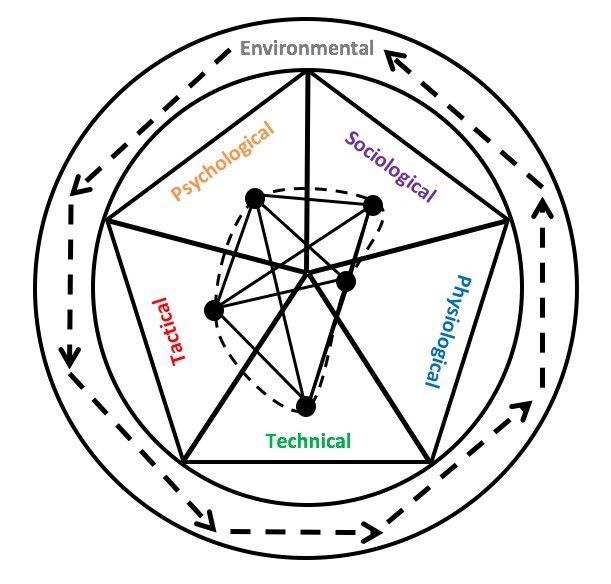
Source: Developing a Football-Specific Talent Identification and Development Profiling Concept – The Locking Wheel Nut Model (Dr Adam L. Kelly, Craig A. Williams, and Mark R. Wilson)
Gareth Bale was a shy, struggling left-back when Harry Redknapp took over at Tottenham Hotspur. Bale had come through Southampton’s renowned academy, but hadn’t made his mark at Spurs and, entering his 20s, there were doubts he ever would. Redknapp moved Bale to a new position, on the wing and later in attacking midfield. Within a few years the Welshman was one of the world’s most dangerous attackers, coveted by the world’s top clubs and eventually signed by Real Madrid for a world record transfer fee.
This anecdote isn’t to portray Redknapp as a soothsayer. Rather, it is to show one example of a manager trying something different, and the player finding a level nobody previously imagined was possible. By radically changing Bale’s position, Redknapp unlocked his talent. Tottenham benefited immensely, and so did the player.
Talking, not listening
The biggest threat to football players nowadays, in my opinion, is coaches putting themselves at centre stage. These are the coaches who talk more than they listen, and think more than they observe. They aren’t looking at what’s in front of them and they care more about their own careers than the people they are supposed to be developing.
During my stint as an assistant with the youth section of a local football club, I remember watching a parent-coach play in goals to even up the numbers in a small-sided training game. It was a typically wet evening in Edinburgh, and this coach was throwing the ball in the air after conceding a shot or a goal. The players, who weren’t all that much bigger than the ball, would struggle to control it in the conditions, give the ball away, and the other team would move upfield and take another shot. This happened four or five times in a row.
The coach in this situation wasn’t seeing what was happening, or even wondering why he was having to make so many saves. He was too busy trying to advise or instruct, and lost sight of the forest for the trees. That session was a futile exercise, with little to no opportunity for players to show what they could do.
Memorising versus problem-solving
I don’t remember much from my school exams. One experience I do vividly remember, though, was one of sheer panic, when the question I planned to answer didn’t show up. My revision was about reading, memorising and repeating. Read, memorise, repeat. Read, memorise, repeat. I didn’t need to make sense of the words in my head; I just had to remember them. But by reading and memorising such highly specific material, I had no idea how to answer this unexpected question. Needless to say, I didn’t get an A on this one (nor a B).
What I took from this and other experiences is that learning how to solve problems is more useful than memorising specific answers to specific problems. When an individual is originating the process of learning, or is at least heavily involved, they have the chance to find their own solutions and take ownership over them. And that is a lot more powerful than a stranger or a textbook telling them.
Coaches that tell players what to do may develop good followers of instructions, but not good problem-solvers, or even good players. Italian football, traditionally, has been filled to the brim with autocratic coaches who instruct every aspect of the team’s game style. And whenever the opponent figures out that style, it’s like watching a machine missing a part. Everything breaks down.
Stealth coaching
Coaches can nonetheless nudge players in a direction, it just needn’t be reduced to training sessions anyone can get online. There’s an art in guiding the discovery.
More good coaching can be done in a one-minute chat than a 90-minute assortment of technical drills. A question can be asked, ideas planted; the player can own the answers and do their own learning. I don’t remember a single technical drill from my 10 years playing football for local clubs and schools, and I’m sure there was no shortage of them. What I do remember is a few comments from coaches on the sidelines, and the occasional silence, which encouraged me, encouraged me to sharpen up, or meant I had to think about my own performance.
I think that famed tennis coach Nick Bolletieri was getting at something in the documentary on his coaching career, Love Means Zero. “Adjustment versus change are totally different,” he said. “When people hear the word ‘change’, their mind goes into convulsions. But if you do a little bit here…and a little bit here, it comes out to be a change and the student doesn’t realise. That’s the trick of being a teacher.”
If I were to boldly encroach on a subject of which I need to learn a lot more, I’d say that coaching isn’t about loud instructions, grand ideas and mimicking the sessions and speech patterns of Emma Hayes or Jurgen Klopp. Instead, it’s a short conversation, an open question, a casual suggestion. Stealth coaching. It doesn’t start and end in training sessions. If it doesn’t resonate, it doesn’t resonate. The player moves on without a second thought, and the coach saves everyone a lot of time and energy. If it does resonate, it may be that the coach just helped that player in the right direction.
Discover more from Women's Soccer Report
Subscribe to get the latest posts sent to your email.
