The U.S. women’s national team returned to the top of the world game at the 2024 Olympics, winning Gold. Along the way they won all six games, four of them inside 90 minutes, required no penalty shoot-outs, and kept four clean sheets. They defeated Germany twice, Zambia, Australia, Japan and Brazil in the final.
In this article I will analyse the team’s play in defence and attack. Here is the team, managed by Emma Hayes:
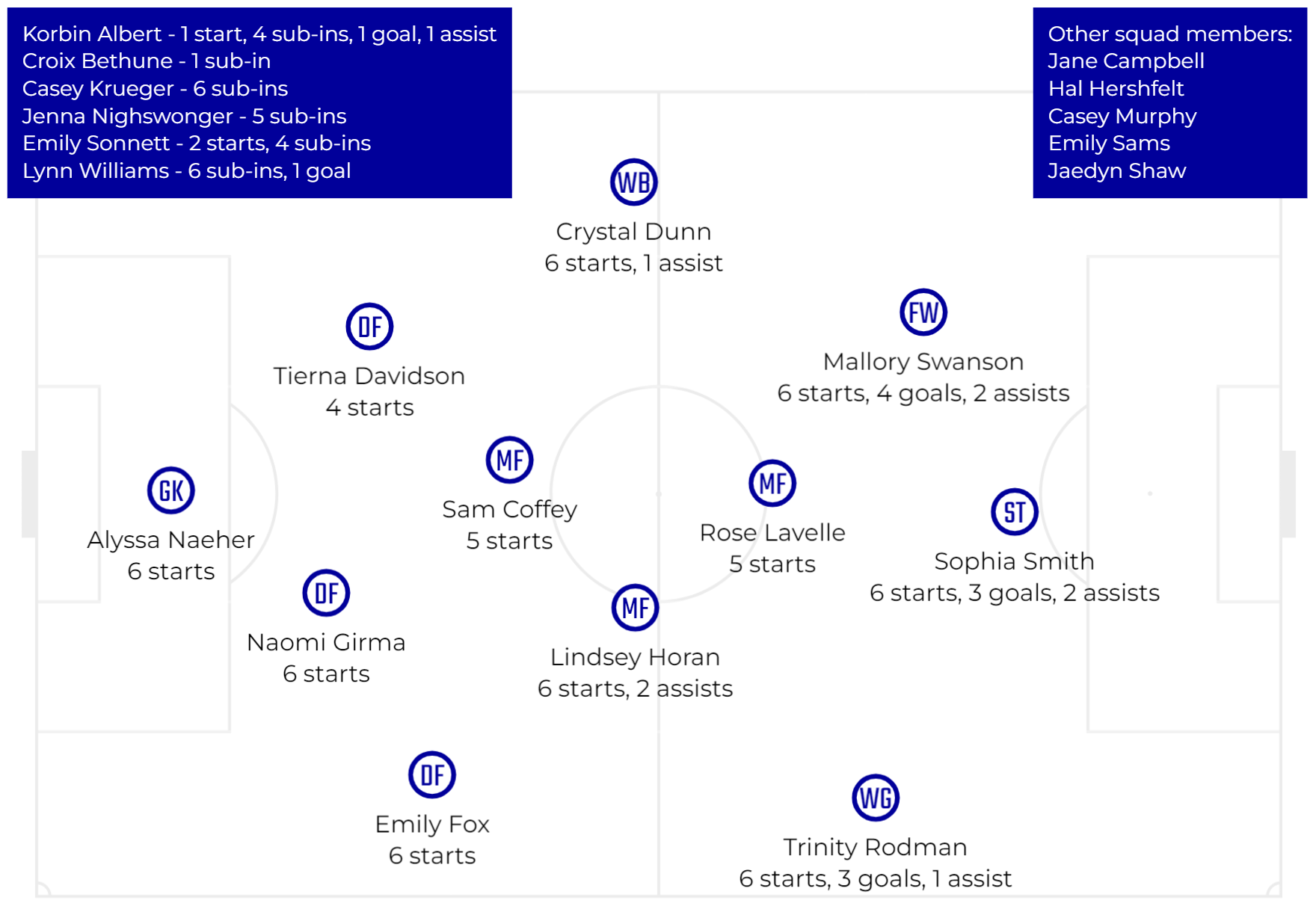
Now, let’s get into the tactical details…
1) Defending In The Moments After Losing Possession
Quick pressure on the ball
When the USA attacked their right-back (Fox) stayed deeper alongside the centre-backs. That meant they had at least three players behind the ball in case of turnovers.
If they lost the ball, the USA would apply quick pressure when possible. The nearest player had the responsibility of closing down the ball-player while two or three teammates moved to mark short passing options, either from in front or goal-side. The aim was to win the ball back quickly after losing it.
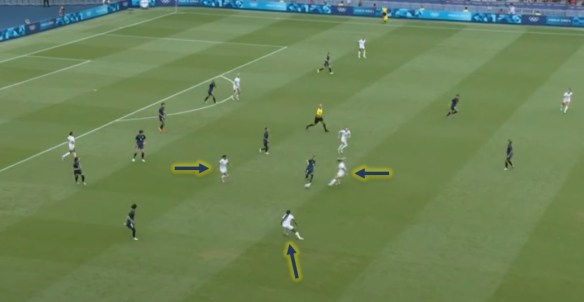
Smith (left) and Albert (right) press the ball-player. Dunn gets closer to passing option
Lavelle stood out in particular for her willingness and speed to chase back, making several important tackles after the USA’s quick pressure was outplayed.
The three-back in closed and open ball scenarios
If the USA were pressing quickly after losing the ball, the three-back would aggressively mark their direct opponents and try to get closer to options between the lines, staying goal-side or level so they could so they could see them and apply pressure on them if they received. (Fox often appeared in advanced central positions to shut down her opponent quickly.)
As a consequence, if the opposition managed to break through the initial pressing and find a forward to feet, they would not be able to turn and run at goal. This also slowed the opponent down and bought time for the midfielders to get back and help out.

USA press after losing the ball. The three-back mark or prepare to close down their direct opponents
If the USA were unable to press quickly, the three-back would be less aggressive in their positioning and marking. They would drop off more, making sure to cover the run of the opposing strikers and delay the counter-attack. Even when caught in even numbers situations (1-v-1, 2-v-2) the USA’s defenders were able to prevent chances with their speed, judgement and 1-v-1 defensive skill.
Zambia provided one of the toughest tests for the back four through the pace of Banda and Mupopo, but the USA still nullified their direct counter-attacks into space.
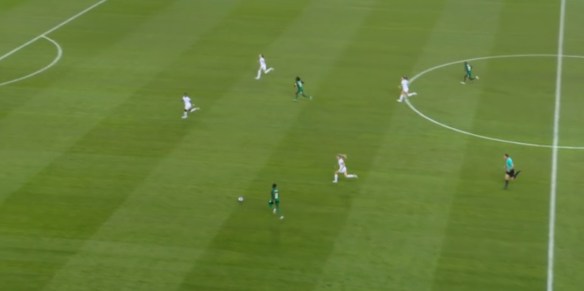
Zambia break. Girma & Davidson back off, cover the striker’s run and delay the counter while midfielders get back to help
2) Organised Defending
High press against short goal kicks
When the opponent played out short from goal kicks, the USA would press high. It often looked like a 4-1-3-2 formation as the front two would move to close down the centre-backs, and a central midfielder would move up to mark their direct opponent. The two wingers would take up balanced positions so that they could support their teammates in midfield if necessary, or close down the receiving full-back if the opponent played out down their flank.

Overview of USA’s shape at a Germany short goal kick
The front two: Not a compact unit
In organised defending from open play, the USA set up in a classic flat 4-4-2. The main focus was to force the opponent away from central midfield, into the wider areas or backwards, where pressing would commence.
The front two would usually be positioned around the opponent’s holding midfielders, but didn’t act as a unit. They tried to control the opponent’s play, screening passes into midfield and pressuring individually depending on who was closest to the receiver.
At times, because they weren’t always a compact unit, the front two could be played between. In those moments, in order for the USA to continue pressing, one of the front two could help back. Lavelle stood out for willingness to press back both in organised defence and transition defence.

Australia play between the USA’s front two
When the front two weren’t able to press back, one of the central midfielders had to step up and try to reduce the opponent’s time and space on the ball. If the central midfielders moved up too late, they could be out-played through give-and-goes. If they stayed in position here, the USA couldn’t press and would instead drop off as a defensive block of four defenders and four midfielders, try to stay compact and slow the attack down.
Forcing the opponent wide
The USA winger on the ball-side would take up a narrow defensive position. This was done to reduce passing angles through the central areas and force the opponent wide, making the opponent’s play more predictable and allowing the full-back and central midfielder on that side to commit more to marking their direct opponent.
Once the opponent went wide, the USA would press. Passes wide were their primary trigger for pressing. Up against a 4-4-2 or 4-3-3 formation, if the opponent went out to their full-backs, the ball-side USA winger would close them down from the inside, using their narrow starting position to screen passes inside.
The ball-side full-back would proactively get closer to the opposition winger at the same time, to ensure quick pressure on a pass down the line. With this pressure, the USA tried to win the ball on the touchline or force the opponent back, where they could step up and press high.
Defending against an opponent using wing-backs
Japan, Australia and Brazil played with wing-backs. In these games, the USA had to change their pressing as a consequence. The near-side winger would continue to take up a narrow position, but would apply pressure on the opposition’s centre-backs when possible. The near-side full-back would then leave their line to close down the opponent’s wing-back. The rest of the defensive back four would remain in a line, covering the ball-side full-back and marking the opposition’s forwards.
Brazil attacked with three quick runners up front in Ludmila, Gabi Portilho and Jheniffer, causing problems for the USA defence. When the U.S. full-back closed down the wide player, Brazil created a 3-v-3 on the rest of the defence and played balls down the line or into space behind for one of them to run onto.
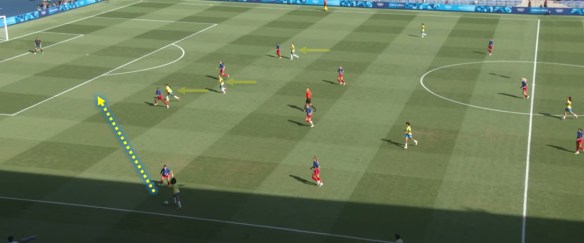
USA defend on the right. Fox closes the wing-back. Brazil play in behind with a 3-v-3 up front
The upside of the USA’s defensive approach against wing-back systems is that it allowed their own wingers to remain in higher positions, rather than needing to cover the entire flank all game. The downside was that this led to a lot of 1-v-1s and dangerous equal numbers situations in the penalty box that the USA had to defend.
Marking tendencies of the back four
In organised defence, the USA back four tried to defend as a unit to squeeze space between the lines and support the pressing. However, they were not purely zonal. They also tried to mark their individual opponents, meaning they all took up different lines depending on their opponent’s position, especially the ball-side full-back.
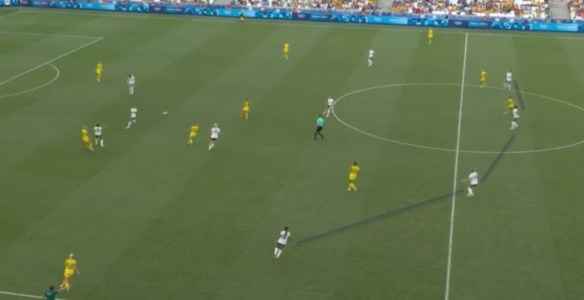
USA back four keeps a line, but position also relates to their direct opponents
In a closed ball scenario, the back four would try to get tighter to their opponents proactively. They would start to drop off more in an open ball scenario, to cover potential runs behind.
In all of the above scenarios, the USA back four did not play for offsides. They kept a rough line to support the press, but stayed goal-side or level and covered their individual opponents. They knew that, if the opponent played over the top or in behind them, they had the speed to match runs, defend 1v1, and in many cases beat their opponent to the ball.

The ball-side full-back (Dunn) gets tight to her opponent. The nearest centre-back (Sonnett) covers her. The other centre-back (Girma) marks the striker
This mixed marking style ensured the midfield was covered whenever they were opened up. If the USA’s pressing failed, the defenders were ready to quickly close down opponents receiving between the lines, stopping them from playing forward. Also, because of their goal-side positioning, the USA’s back line was extremely difficult to open up through a ball over the top. They often had a head start in foot races, could see the run, and had the speed to match runs if necessary.
Defending on the right: Rodman tracks back
On the right side, Rodman was able to cover large distances throughout games, at times acting like an auxiliary wing-back. Her defensive recovery, speed and high work rate helped to ensure Fox was rarely isolated 1v1 or out-numbered. Regularly, Fox could be aggressive in her marking in the knowledge that Rodman would track runs either side of her or even fill in for her if she was drawn out of position.
Defending on the left: Preventing Dunn from becoming isolated
Swanson often played on the left of the midfield four in the USA’s defensive 4-4-2. She didn’t track back to the same extent as Rodman and sometimes would gamble with her defensive position, staying higher up the field so she was available to exploit space quickly on the counter-attack. However, this meant that Dunn could be isolated or outnumbered at times.
In these cases, it was crucial for the USA’s ball-side central midfielder to cover any runs made inside of their left-back. Coffey was particularly good at anticipating and matching these runs, winning the ball or at least reducing the runner’s time and crossing angles.

Dunn closes down Brand on the touchline. Coffey moves to track the run inside
Defending switches of play
Up against teams playing with wing-backs, the USA full-backs could be overloaded on switch balls. This was particularly evident vs. Japan, who attacked in a 3-4-3 formation and often pushed both wing-backs up at the same time.
If the Japan left wing-back were to have switched the ball to the other side, Dunn was often left 1-v-2 up against a forward and a wing-back. However, if Japan switched from the USA’s left to right, Rodman tracked back to cover the run of Japan’s left wing-back and make sure Fox wasn’t out-numbered.

Japan build left to right. Dunn marks her opponent. Japan have a free player on the right
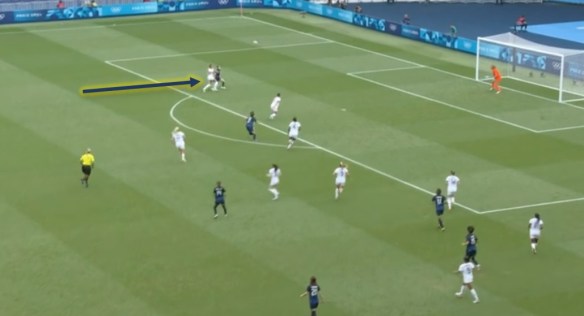
Japan switch right to left. Rodman covers the run outside of Fox, prevents a free player
In the final against Brazil, the USA adjusted defensive system to a lop-sided 4-3-3. This ensured their full-backs could not be isolated on switch balls as their opposition built up from the back. Swanson started higher up on the left so she could help close down Brazil’s three centre-backs. Rodman started in a deeper position to cover a possible switch out to Brazil’s left wing-back.
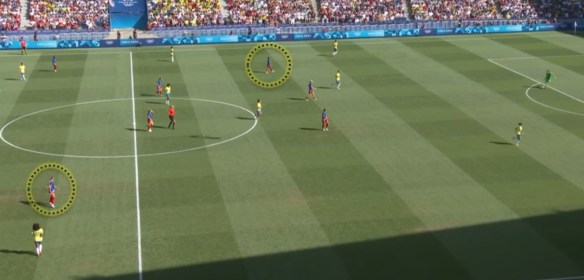
Rodman (bottom-left) covers the left wing-back. Swanson (top) ready to press the centre-back
Defending the penalty box
The USA encountered some issues when defending their box. Naeher prefers to stay on her line, while the back four lacked aerial dominance, meaning they didn’t always get first contact on a high ball into the box and had to make last-ditch clearances and blocks.
The back four were often forced to defend in isolation as the midfielders rarely dropped in to fill gaps or double mark with the defenders. This could lead to 1-v-1 situations across the six-yard area. However, the excellent positioning of the defenders meant they regularly got between the opponent and the goal to intercept the attack or at least block the shot attempt.
Girma prefers to mark space and get in the way of crosses and shots, rather than marking an opponent and contesting an aerial duel. Sometimes she lost sight of her opponent and left them free on crosses into the box, which was dangerous, but she also intercepted a lot of attacks with her positioning.

Girma loose marking of opponent in her zone on a low cross leads to a Germany chance
Fox was excellent defending the back post on crosses from the other side, showing awareness, commitment and bravery to make contact before her opponent or deny them a free shot. Also you can see in the above graphic, Rodman came back at times to prevent her being overloaded 1-v-2. Furthermore, Rodman has the aerial ability necessary to compete on high balls.
3) Attacking In The Moments After Winning The Ball
Finding the front two with a ball to feet
When the USA won possession, their first thought was to attack with the ball on the ground. They would look to feed one of the front two (Smith and Lavelle or Swanson) with a ball to their feet, so that they could turn and dribble.
While this pass was played, both wide players would begin their runs on the outside of the defence. This could present a challenge for the opponent: apply pressure against the front two, or drop off to cover the runs on the outside?
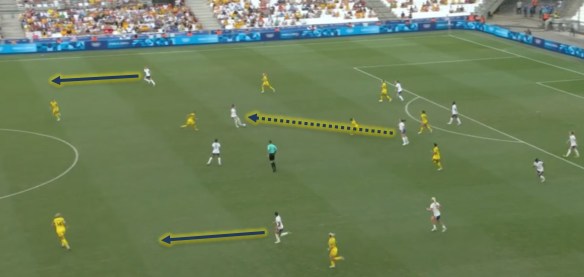
Coffey finds Lavelle with a pass to feet. Rodman & Swanson attack space outside the defence
The speed of USA’s front four (Smith, Lavelle, Swanson, Rodman) meant that they could exploit space in transition quicker than the opponent got back to recover position. If Smith, Lavelle or Swanson were able to turn or combine out of pressure and dribble forward, it was extremely difficult for the opposition to stop the counter-attack. They had to foul, or hope for a misplaced pass.
Exploiting space quickly
When the USA won the ball, generally they looked to attack space as quickly as possible while keeping the ball under control. If they were in a position to do so, they would try to exploit any available space either side of the opponent or behind their defence. Still, the preference was to keep the ball on the ground and build the counter with accurate short passing, to avoid the game becoming too end-to-end and transitional.
Sometimes when on the left side of the midfield four, Swanson would gamble with her defensive position, staying higher up rather than tracking back. This meant she was available to attack space quickly after a turnover, especially if the opposition right-back did not adjust accordingly and went forward to support the attack.
Against Brazil, Swanson had a higher defensive position and the USA looked to exploit space behind the defence quickly more often. Brazil had three strong centre-backs who marked aggressively, so the idea was to turn them and play into space rather than to the feet, giving Smith and Swanson an opportunity to run onto the ball and beat their opponent for speed, rather than receiving back to goal under intense pressure from physical defenders.
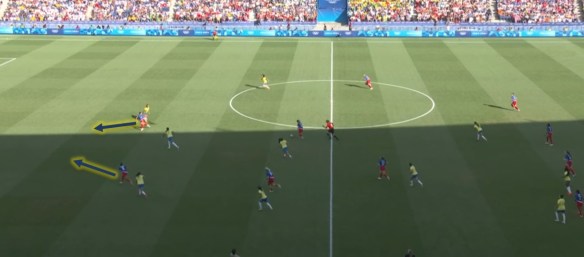
USA counter against Brazil. Swanson and Smith look to attack space behind the defence
Occasionally, opponents were able to rush the USA with quick pressure immediately after they had regained the ball. In these moments, one option was a simple clearance ball in the direction of Smith or Swanson. Smith was particularly dangerous in these moments, at times making something from nothing.
Thanks to her speed, she could latch onto long balls or create pressure on the defender. Her pace and work rate led to attacking opportunities as the defender could not hold her off in a 1-v-1 physical match-up or panicked under pressure. Sometimes her mere presence appeared to create tension in the defence.
Resetting under pressure
If the opponent applied effective pressure in transition, the USA would have to reset, going back to the defenders or the goalkeeper. Girma’s movement in these situations was good, to create an angle that allowed the team to retain possession. Alternatively, they would go back to Naeher and she would look to pick out one of the defenders across the width of the field.
4) Organised Attacking
Utilising the three-back for patient build-up play
In organised attacks, the USA set up with a three-back (3-2-4-1 or 3-1-4-2 formation predominantly). The right-back would stay in a line next to the two centre-backs. These three players would cover most of the width of the field, giving the USA a variety of angles forward. They were patient in their build-up play, shifting the ball side to side along the back line. This continuous short passing gave the team more time to set up their attacking structure and movements.
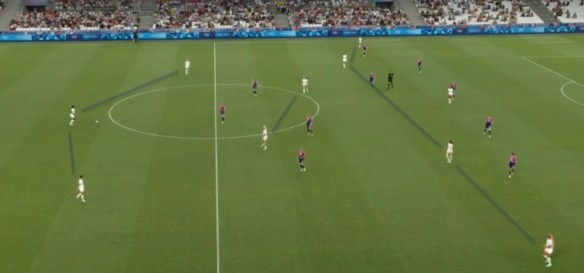
USA build up in a 3-2-4-1 shape in their group game against Germany
The three-back gave the USA numerical superiority in their first line of attack. Most opponents couldn’t press them high, and those that tried struggled to do so effectively. The USA were able to reset if they came under pressure through Girma deepening her position, or by going back to Naeher, the goalkeeper. Naeher then had three short passing options to play across most of the width of the field.
Japan pressed the USA well, with a narrow front three to screen passes into midfield and get pressure on the USA three-back. Still, they failed to win the ball from their high press, and could only slow the build-up down.
Movements to find space and progress
The only major changes to the attacking system throughout the tournament concerned whether to build up with one or two midfielders in front of the three-back. Sometimes Coffey was joined by Horan, at other times Horan started in a higher position. Sometimes the USA alternated between 3-2-4-1 and 3-1-4-2 attacking formations during the same game.
As the ball was moved across their back line, the USA’s attacking players took it in turns showing for the ball to feet. They tried to time their movement to arrive in space. It was important for multiple players not to perform the same movement at the same time, otherwise the opponent would have a simple decision to make.
Through specific positioning and opposite movements, the attacking players tried to confuse the back line. This could lead to space to play between or behind the opposition’s lines.

Swanson shows for the ball into feet between. Smith runs for the ball into space behind
Building attacks against an opponent using man-marking
Brazil defended by matching up player-for-player all over the field, as they did in their semi-final win over Spain. This meant that the USA had minimal space and time on the ball. Brazil’s aggressive marking style meant they could apply immediate pressure on the receiver and they had the physicality to stop the attacker from turning.
Up against such an aggressive marking style, and in a high-pressure final game, the USA were more direct. Rather than risk passes into attacking players under pressure with their back to goal, they tried to play over the top of the press and look for second balls to counter-attack from. From goal kicks, Naeher went long, aiming for Horan.

USA long goal kick to Horan. Smith and Rodman make runs for the flick-on
The difference in options on each wing
The wide player on the ball side would try to drop as the ball was being shifted across the back line towards them.
If Dunn or Nighswonger received on the left under pressure, they looked to retain possession by going back to the three-back, or feeding a short option inside-left. If they had time on the ball, they looked to feed a player showing between the lines, or a runner in behind such as Smith.
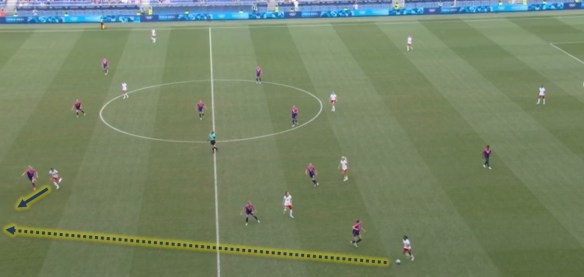
Smith runs the channel and Dunn passes to her
If Rodman received on the right under pressure, she typically looked for a quick combination with a teammate inside-right, usually a give-and-go to release her in behind the opposition left-back. If she had time to play, she sometimes looked for an attacker showing between the lines (often Smith showed for these lateral passes). However, with trickery, speed and powerful running, Rodman could also try to beat her direct opponent 1-v-1 around the outside and get into a crossing position using her individual skills.
Outnumbering the wider areas against opponents using a 5-2-3 formation
Against the 5-2-3 defensive formations used by Australia and Japan, the USA’s attacking midfielders would sometimes move laterally to the side of the opposition’s defensive block.
As the opponent defended with a narrow front three and only two central midfielders, they would not be able to follow these movements without losing defensive balance. This could lead to 2-v-1 situations for the USA in the wider areas, with their attacking midfielder and wide player overloading the opposition’s wing-back on that side.
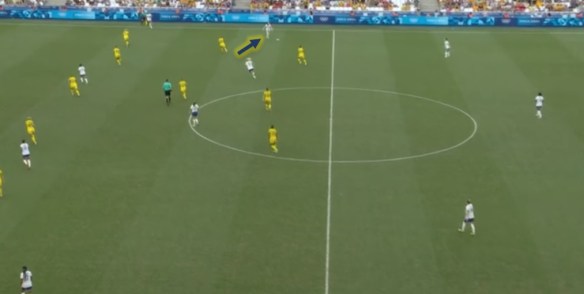
Lavelle moves wide right to receive in space outside Australia’s 5-2-3 block
Progressing through the centre: Smith’s movement into space between lines
Smith played a vital role in showing for the ball between the lines. Her back-to-goal play has improved, showing strength under physical pressure. She was able to control the ball and often tried to take it on the turn. If she got past her marker or had time to turn, she could run at the back line at speed and try to feed a runner behind.
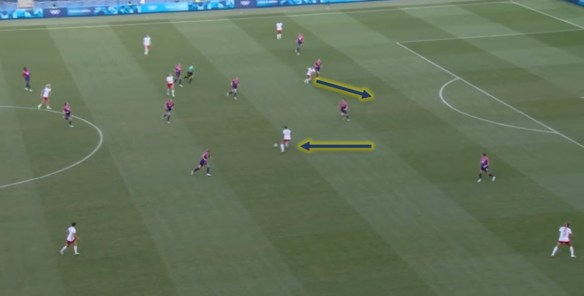
Smith shows for ball between lines (Swanson makes run in behind – opposite movements)
The distance between players made it hard for the USA to play one- and two-touch combinations, often leaving them in 1-v-1s. The other attackers struggled to contribute as much as Smith in these situations, because they lacked either the strength or speed to turn their marker so consistently. Horan tried to play one-touch passes ‘around the corner’ to a more advanced teammate, but the lack of connection between attackers made these difficult to complete.
If the opponent failed to mark Swanson, Smith or Lavelle showing between the lines, these players could all dribble at speed, forcing the opposition back line to collapse in and creating space outside for Rodman and Dunn.
Switching play to utilise Rodman’s skill set
When the USA had possession towards the left side, they regularly looked to find Rodman directly with a long diagonal ball to the right wing. Coffey’s passing range was particularly important here. These quick switches of play were done to get Rodman on the ball in space, before the opponent could get tight to her with adequate cover inside.
In space, Rodman could gather momentum going into a 1-v-1 and beat her opponent with an explosive change of pace on the outside. She could also cut in on her left foot and shoot, rather than cross. Rodman scored the winning goal against Japan this way.
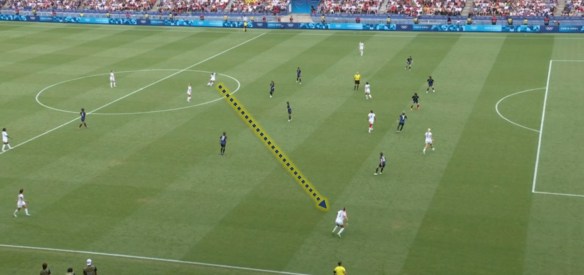
Build-up to the winning goal vs. Japan. Switch of play from Dunn to Rodman on the right wing
Progressing on the right: Finding Smith’s channel run
A pattern that was regularly seen when the USA built up on the right-hand side was a ball over the top for Smith. With Rodman and another attacker occupying defenders on that side, space could open up behind. Smith would run the channel and try to latch onto a ball over the top by Fox.
This was often used by the USA as a release out of pressure. Smith’s pace meant the ball did not have to be precise for her to receive, and it offered a quick, direct way up the field. At worst, it turned the opponent and gave them something to think about defensively, rather than inviting further pressure.
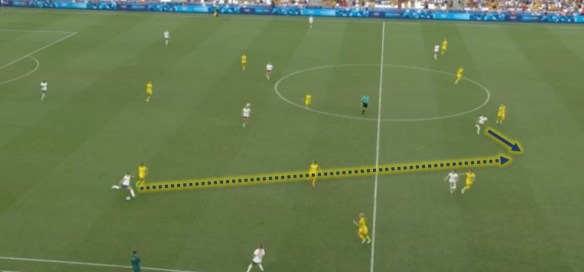
Rodman & Lavelle attract defenders. Smith runs the channel, Fox plays her in behind
Why they were more dynamic attacking on the right side
The USA were dynamic attacking down the right-hand side particularly. This is in part because of Rodman’s 1-v-1 ability on the right flank, but also because the players on that side were naturally right-footed, allowing for more natural quick combination play (as opposed to the natural right-footers on the left-hand side).
There were also more opportunities to combine on the right flank as Fox would make timed forward runs to support the attack on that side, running inside or outside of Rodman, and trying to outnumber the opponent. On the left, by contrast, Davidson and Sonnett preferred to keep their position and pass to those in more advanced areas.

Fox times her forward run as the attack develops to outnumber on the right-hand side (3-v-2)
Final third play: Low crosses and cut-backs
Once they got into the final third, the USA tried to open up the last line of defence. Usually, they tried to feed a striker in behind to shoot, or play a runner in behind on the outside to cross low or cut back from near the by-line.
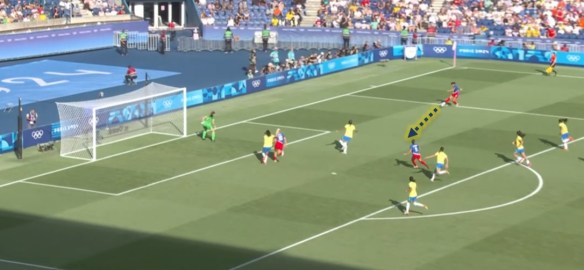
Smith cuts back. Horan attacks front post. Swanson hits penalty spot
They were dangerous when entering through the centre with a dribble from Smith, Swanson or Lavelle, to collapse the defence and create space around the outside for Rodman or Dunn. They were also dangerous attacking from the right side, with Rodman’s skill, accurate final ball and ability to shoot off either foot.
When the USA got in on the right, Dunn would attack the left-hand side of the penalty box. This way, if a striker or attacking midfielder couldn’t finish at the near post or penalty spot, if the opponent failed to clear properly or if space was left open, Dunn was there to pick up and shoot.
The alternative: Horan’s aerial threat
While the USA primarily tried to enter the penalty box with the ball on the ground, they weren’t always able to do so. When opponents defended in numbers and took away the space behind, low crosses and cut-backs became harder to create. An alternative solution in these moments was the high cross, particularly a diagonal ball towards the far post area, for Horan to attack in the air.
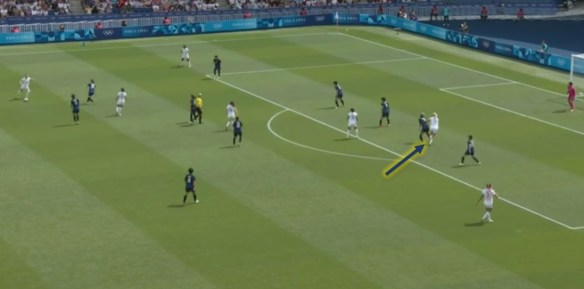
Horan runs on blind side of defender, looking to attack an early ball into the box
Horan’s height, strength and heading technique make her a goal threat on aerial balls, and she is able to ghost in with a run from deep, often on the blind side of defenders. On a number of occasions against a set defence, this led to a headed shot on goal or a knock-down for a teammate to shoot.
Movement in the penalty box
When attacking the box on a low cross or cut back, the USA sometimes lacked numbers arriving to finish the chances they created. Generally they got between one and three players into the box in these scenarios, and they tried to attack different areas. There was good movement from the forwards, utilising double moves to separate from their markers.
Smith offered variety with her movement, sometimes dropping off to the penalty spot to receive a cut back, at other times trying to attack the near post area. She made an effort to stay blind side of her marker, then arrive in front at the last moment. This meant that the defender couldn’t see both her and the ball, and made it harder to get in front of Smith and make first contact with the ball in.
Summary and talking points
To summarise, here is a brief overview of the USWNT’s play in the four main phases of the game.
After losing possession: The USA would try to win the ball quickly, with good pressure early on in the tournament. In the final games, this quick pressing wasn’t as evident, perhaps due to tiredness. They became more reliant on a strong defensive line to delay counter-attacks and prevent clear shots on goal, with excellent 1-v-1 defending particularly from Girma and Fox.
Organised defending: The USA defended in a flat 4-4-2 and attempted to force their opposition wide before pressing man-to-man on the touchline. At times lacking compactness, their back four was vital. So too was the work ethic and engine of Rodman, whose recovery runs ensured Fox was not overloaded, and Coffey, whose energy, run-tracking and filling in helped to plug gaps in the back line.
After winning possession: The USA would look to play forward quickly, with the ball on the ground. They aimed for their front two with ball into feet, while the wide players attacked space outside of the defence. At times, they counter-attacked more directly, playing into space for Smith and Swanson to run onto the ball. Their speed and 1-v-1 dribbling ability in space was a real threat to all opponents.
Organised attacking: The USA attacked mostly in a 3-2-4-1 or 3-1-4-2, with fluidity in the movements of the front players. They were patient in possession, attempted to confuse opponents through opposite movements, and outnumbered different areas of the field to try and make a free player. They were flexible in their attacking style, though mostly tried to play through or around their opposition, before playing low crosses or cut-backs for Smith, Swanson, Rodman and Lavelle to finish on the ground. Horan offered an alternative aerial threat on high balls.
Other talking points are:
Hayes’ decision not to rotate players. This was based on data suggesting successful tournament teams tend to avoid rotation. I’d like to know more about whether this data is really suggestive of teams that don’t change win more, or that teams don’t change because they are winning. Nonetheless, the two sides of this coin are: 1) Hayes saw it as necessary to build cohesion in a short space of time working with the squad, and 2) It may well have led to tiredness in the later stages of the tournament, in my opinion particularly affecting the team’s quick press after losing possession.
Natural playing roles. For the first time in years, U.S. players look as good for their national team as they do for their clubs. Is that because they are playing in more natural roles? Rodman on the right wing, Smith through the middle, Swanson with positional freedom, Horan box-to-box…all of this is what we see from them at club level. Also, Fox has enjoyed a massive simplification in her role, in my opinion. No more wandering midfield, more straightforward overlapping/underlapping runs. The only player that didn’t play their ‘club’ role was Dunn, and even then, she has played left-back for the national team well in the past.
Familiar principles, improved execution. Hayes’ predecessor, Vlatko Andonovski, tried to instil similar basic principles of play. He implemented a narrow front three for more options between lines to play through, and to confuse defences with opposite movements. He had the full-backs perform different roles (one back/inside, one up/wide). He tried to get the team playing with more ball possession, and more short passing. The difference here is the execution. Under Hayes, the team looks more confident and willing to take risks on an individual level. Rodman and Smith in particular look less inhibited. If it isn’t change in ‘tactics’, or change in players, can we assume this is about the quality of coaching?
Thank you for reading!
Discover more from Women's Soccer Report
Subscribe to get the latest posts sent to your email.
