The Orlando Pride established themselves as top dogs in the NWSL before the mid-season break thanks to a 2-1 away win over the Kansas City Current.
This game had big “see you in a few months for the Championship” vibes. It was a massive win for Orlando, all the more so because they were reduced to 10 players before half-time when right-back Carrie Lawrence picked up her second yellow card.
Orlando’s red card, the Chawinga effect
In a first half full of physical battles, fouls and gamesmanship, a sending off was all but inevitable. And Lawrence was a prime candidate, given her unenviable task of marking Temwa Chawinga.
Kansas City likes to play Chawinga off-centre. Not right through the middle, not out on the wing, but somewhere in-between. To enable this, they have one full-back push high down their flank—Izzy Rodriguez on this occasion, so Chawinga could play inside-left.
This inside position—halfway between the wing and the centre, and the opponent’s defence and midfield—suits Chawinga for two reasons:
- It means she isn’t directly up against a centre-back, and can make more unobstructed/undetected runs behind, often on their blind side
- She can hit full speed before reaching the last line, making her almost impossible to catch up with if Kansas City plays her in
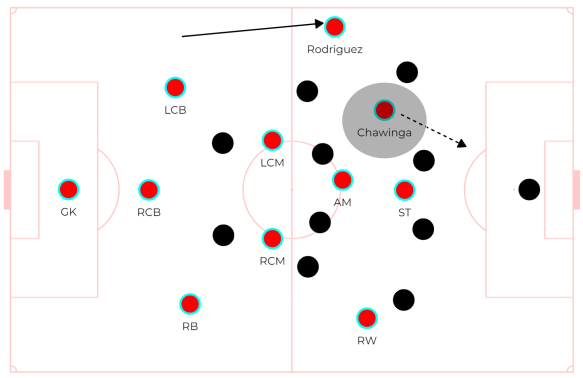
Basic overview of Chawinga’s inside position within KC’s attacking setup
Orlando head coach Seb Hines set his team up to defend this unique dynamic by having their right winger track back with Rodriguez so their right-back, Lawrence, could keep tabs on Chawinga.
Lawrence stayed tight, but Chawinga used her body well to roll her on a couple of occasions. One of these moments led to her brilliant solo goal and an equaliser for Kansas City after Barbra Banda had put Orlando 1-0 up minutes previously. Two other instances of Chawinga getting away from Lawrence led to yellow cards, and a sending off.
Orlando had over half a game to defend, a player down, against one of the most dangerous attacks in NWSL history.
After the red, the Banda effect
Except, Orlando didn’t just defend for the next 45 minutes plus. In the 63rd minute, they re-took the lead through a Marta penalty. That spot kick originated from a counter-attack led by Banda, whose importance grew after Orlando went down a player.
Orlando doesn’t simply hit and hope for Banda. Early in this game, they attacked from a back three, with Lawrence tucking in alongside the centre-backs. Left-back Kerry Abello pushed up on her flank, while right winger Julie Doyle offered width on the other side.
Kansas City kept their attacking quartet fairly narrow, presumably to 1) block passes through to Marta and Adriana, and perhaps 2) to ensure Chawinga could stay upfield and threaten on the break. Consequently, Kansas City’s full-backs were responsible for closing down Orlando’s wide players.
End result = Banda getting 1-v-1 against KC centre-backs in the channels.
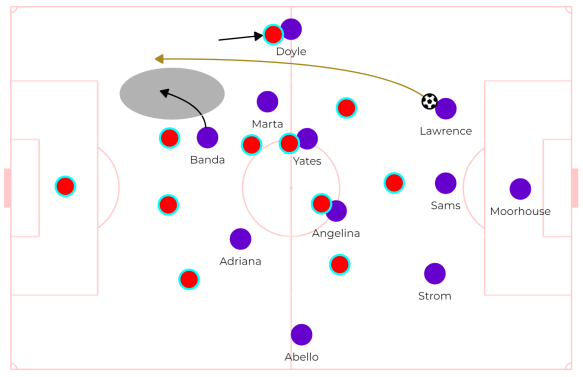
Basic overview of Orlando’s attacking setup.
Banda doesn’t need a specific ball or setup to impact the game, though. She has the speed, strength and anticipation to profit off of loose balls, aerial and physical duels. Even after Orlando went down a player, she offered a great out-ball.
Stine Ballisager had a particularly tough time keeping Banda under wraps, but in the end it was Rodriguez who got rolled in a loose ball battle leading up to Orlando’s penalty kick award.
Vlatko v the low block
As the second half went on, Orlando did something most teams would do with a lead to protect and one less player: they compressed the space needed to defend. By defending a smaller area they could make it easier to ensure coverage or doubling up on Kansas City’s attacking options.
This picture shows the tackles, interceptions, blocks and recoveries made by Orlando in the first and second halves of this game. As you can see, they defended deeper in the second half.
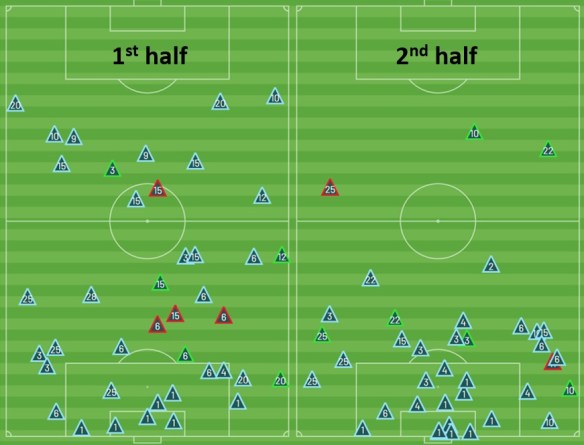
For Vlatko Andonovski, this is a defensive strategy he continuously struggled to overcome while in charge of the United States national team. And his Kansas City side consistently found themselves running into defenders as they searched desperately for an equaliser.
Orlando’s basic approach didn’t change. They went from a 4-4-2 to a 4-4-1. Their right winger (initially Julie Doyle, then Marta, then Ally Watt) continued to track back with Izzy Rodriguez, allowing Orlando’s back four to remain compact and cover Chawinga + Debinha.

Snapshot of Orlando’s second half defensive setup.
As Vlatko’s USWNT often did, Kansas City found themselves trying, and failing, to combine through the low block. This isn’t really what KC excels at. They enjoy having space to attack, particularly to exploit Chawinga’s blistering speed and movement in behind. In this case it also meant—counterintuitively—that they weren’t stretching an out-numbered opponent, making them run.
Orlando wanted to defend as small a space as possible. Too often, Kansas City obliged.
It wasn’t until the Current brought on Brazilian defender Lauren as a makeshift target striker that they looked dangerous. There was greater urgency and some good “early” crosses into the box for Lauren to attack. Still, there was no real co-ordination about this play (support/third-player runs, anticipation to find a shooting chance).
Orlando went to a 5-3-1 or even 6-2-1 formation towards the end to ensure a numerical advantage in their own penalty area, inviting KC to cross and gambling on their ability to clear their lines. In the end, they held on. Three points, but more importantly a psychological marker: the NWSL’s best defence overcame the NWSL’s best offence.
Discover more from Women's Soccer Report
Subscribe to get the latest posts sent to your email.

Another great one! I’m so glad I found these!
LikeLiked by 1 person