Temwa Chawinga is one of the most exciting players in the NWSL right now. The 25-year-old Malawian joined the Kansas City Current in January after several years spent in China. In her first four games with the Current, she has scored two and set up two, forming a devastating combination with Bia Zaneratto along the way.
While starting on the right side of Kansas City’s attack, Chawinga is not a classical winger who dribbles or crosses. Rather, she is a wide forward, someone who causes more damage on the run. Her movement is good, and she is constantly looking for opportunities to get in behind the opponent’s last line. She is also one of the fastest players, perhaps the fastest, that you are likely to find in the NWSL today.
During Kansas City’s 1-1 draw with reigning champions Gotham FC, we saw the headaches Chawinga’s pace and movement cause defences. We also saw the knock-on effect it can have on the game as a whole.
Gotham started the game, as they always do, trying to keep a high line and playing for offsides. There was little to no recognition of the specific threat Chawinga posed. Seven minutes in, after a throw-in to Bia down the flank, Chawinga moved inside and anticipated a ball over the top from the resulting skirmish. Look at the body shape of Gotham’s last defenders. Maitane Lopez and Bruninha are facing fully forward. Sam Hiatt is the only one half-turned.
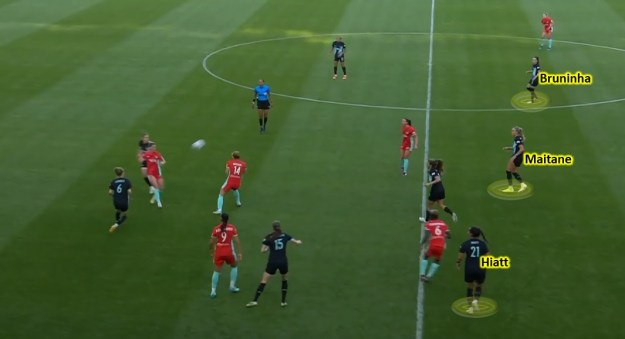
The line is also very high, almost on halfway. So not only are the defenders ill-prepared to keep up with Chawinga (two of the three remaining need to turn before they start running), but they are also giving up a huge amount of space behind (Hiatt may be half-turned and more prepared, but hasn’t got enough of a head start here, which she would definitely need).
The end result? It isn’t the ideal ball, scooped up in the air, so Chawinga doesn’t get the chance to hit top speed on the run. She has to get the ball under control first, which gives time for Maitane to get back. Still, Chawinga has too much pace, and too much space to run into.
Chawinga scored Kansas City’s only goal of the game, in the 17th minute. It came on a counter-attack following a Gotham corner. Bia knocked over her opponent in a tussle for the ball, then timed the release and weighted her through ball to perfection for Chawinga to run onto and finish.
There’s not an awful lot the Gotham players could do in the situation. Chawinga + Bia is a superb double act. Sometimes you just have to hold up your hands and say: too good. Maybe, maybe, Gotham’s last defenders could have anticipated Chawinga’s run quicker and got sprinting a little earlier. But it probably still wouldn’t have been enough to deny the Malawian Missile.
Later in the first half, we again saw Gotham’s instincts not to track Chawinga’s run, but to try and keep their line high and catch her offside. Only their line wasn’t organised well enough to do so. Here, Maitane steps up while the far-side defenders drop back. Chawinga is un-tracked and onside, a bad combination.
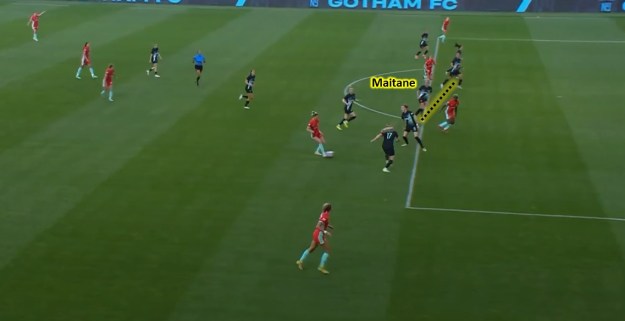
Gotham head coach Juan Carlos Amoros chose to play Tierna Davidson at left full-back for this game, dropping Jenna Nighswonger to the bench. The idea, it seemed, was to put a natural central defender up against Chawinga, to try and reduce her influence. Only, once the whistle blew, Davidson played just like the Gotham left full-back normally plays: pushing high up the field.
Look at how high down the left flank Davidson got in the 10th minute. This happened a few times, it wasn’t a one-off.
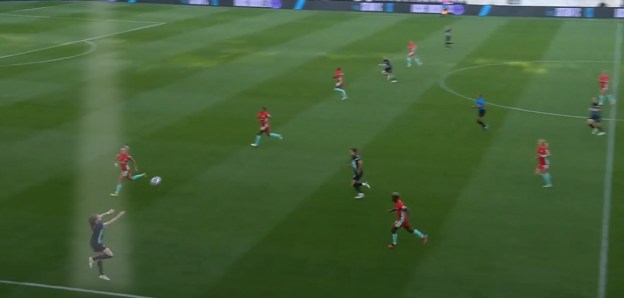
In my head, Davidson would stay back at all times, making sure to always be somewhere between Chawinga and the goal, to control her forward runs.
In reality, Davidson ran the flank like a typical attack-minded full-back. That meant that, if and when Gotham gave the ball away, that space in transition outside Gotham’s centre-backs was open for Chawinga, and there’s no way Davidson wins that particular foot race.
For the second half, Amoros brought on Nighswonger and shifted Davidson back into her customary centre-back position. This changed the dynamic of the game in a few ways.
Now Gotham had a left centre-back who could spray long balls with accuracy, and a left full-back who was actually comfortable attacking the flank and can produce something when she gets upfield. Chawinga had a lot more tracking back of her own to do, which took her further away from goal.
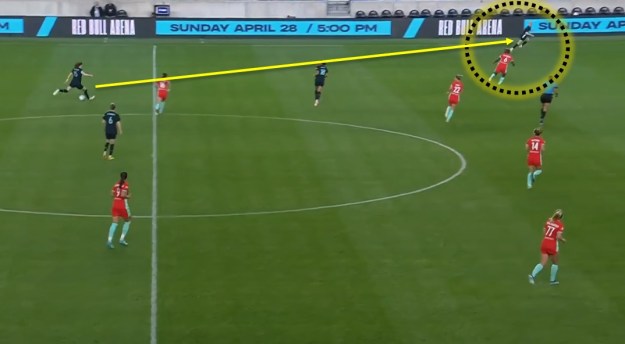
This also impacted Gotham’s defensive dynamic. Davidson could now defend with Chawinga in front of her, rather than running behind her or in counter-attacking foot races.
Nighswonger, meanwhile, has more speed and agility than Davidson. She is able to recover position quicker, and was much better suited to a close marking job on Chawinga.
There may remain valid question marks over Nighswonger’s 1v1 defensive ability, and she will always struggle to defend the back post on aerial balls. But when it came to keeping up with Chawinga, she did a good job in the second half of this game. Here are a few examples. The ball doesn’t end up with Chawinga, but that’s not the point. Nighswonger was proactive in snuffing out her space.
Gotham seemed to abandon their usual all-out zonal back line and offside traps. It wasn’t Catenaccio, but the marking of Chawinga was more individual. Generally, wherever she went, Nighswonger followed, while the defence as a whole appeared less inclined to push up and quicker to drop off when they were being run at.
Another element regarding this man-marking assignment, of course, is it becomes less about the unit organisation, and more about the individual player and their defensive decision-making. When Chawinga moved inside in the 77th minute, Nighswonger passed marking responsibility—correctly—onto Davidson. But, without Chawinga to focus on, she completely spaced on a run from deep by Bayley Feist. She even checks her shoulder and presumably could see Feist coming, but doesn’t proactively pick her up.
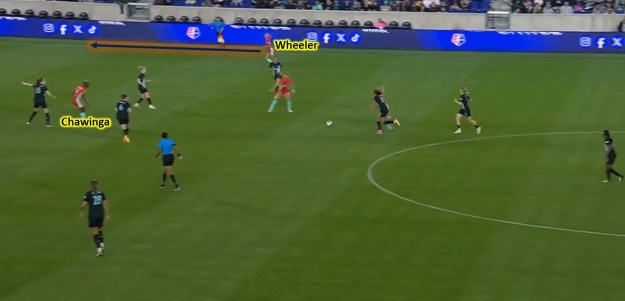
Another important aspect of the Kansas City Current attack that opponents must take note of is the movement of their right full-back, Ellie Wheeler. She often plays like a right winger offensively, overlapping and even attacking the back post on occasion when crosses come in from the other side.
When defences—like Gotham’s here—get sucked in to mark or double up on Chawinga, alongside Bia and potentially even Debinha when fit—they leave space on the outside, and Wheeler eats that space up on the right. She already has a goal to her name this season and could have had another, purely from shooting off second balls or crashing that back post for headers.
Gotham did a good job of bottling up Wheeler’s overlapping runs, with Delanie Sheehan in the first half and the ever-reliable Lynn Williams in the second. Still there were times, like the one below in the 75th minute, where Kansas City could have exploited the space outside-right to feed Wheeler and get into a dangerous position.
This game was yet another example of the pressure Kansas City put on defences, with the sheer quality, numbers and movement of their attacking players. It also once again highlighted the issues Gotham have applying their defensive principles against opponents with fast forwards and clever runners. How long until someone keeps a clean sheet against KC? And will Gotham ever give up the high line, or is it wired into their DNA forever?
To sum up, here are the key points from this match:
- Gotham’s high line, leaving lots of space for Chawinga to run into
- Gotham defenders body shapes, making it harder to keep up with Chawinga
- Nighswonger being more suited to the marking job than Davidson was
- Davidson diagonals & Nighswonger overlaps gave Chawinga more defensive work of her own
- If your left-back follows Chawinga, who covers Wheeler’s overlapping runs?
Discover more from Women's Soccer Report
Subscribe to get the latest posts sent to your email.
