The Utah Royals kicked off their 2024 National Women’s Soccer League campaign with a 2-0 home defeat to the Chicago Red Stars. This despite dominating the ball. The Royals enjoyed 67% possession in the game. If we say the ball is in-play for around one hour, that’s 40 minutes where they were trying to attack their opposition. Yet they finished with just five shots on target, the same amount as their visitors, and an L on their record.
How so? Well, the most obvious reason was the movement of their midfielders, or—as we will soon see—the lack thereof.
In her first game as a head coach, Amy Rodriguez set Utah up in a 4-3-3. One holding midfielder, Agnes Nyberg, and two in more advanced positions, Frankie Tagliaferri and Dana Foederer. Chicago, now coached by former Jamaica boss Lorne Donaldson, set up to defend in a standard 4-4-2 formation. Their front two marked Nyberg zonally from in front, shifting side to side as a unit in an attempt to reduce Utah’s passing angles into their holding midfielder.
Utah’s goalkeeper, Carly Nelson, came well off her line to get involved in build-up play with the centre-backs, Kate Del Fava and Kaleigh Riehl. This trio had lots of touches and passes between them, but came under virtually no pressure from Chicago’s frontline (only when a Utah centre-back drove forward would they be closed down). We can describe this as ‘default possession’, because Chicago were evidently comfortable allowing Utah’s centre-backs and goalkeeper to have the ball.
The problem for Utah was turning this time and space on the ball into something more meaningful. As it turned out, they found it extremely difficult to find their midfielders with a ball into feet.
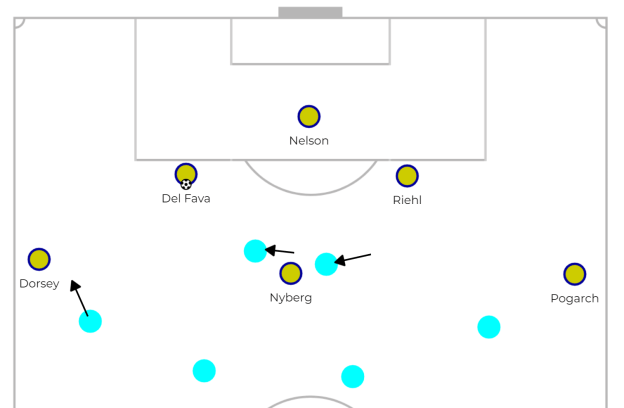
Nyberg was doubled up on by Chicago’s front two. She did her best to move and make an angle, but her options were severely restricted. What compounded this was the lack of another midfielder showing for the ball. Consequently, the situation when a Utah centre-back had the ball often looked like this. As you can see, beyond Nyberg, there isn’t another Utah player in the picture.
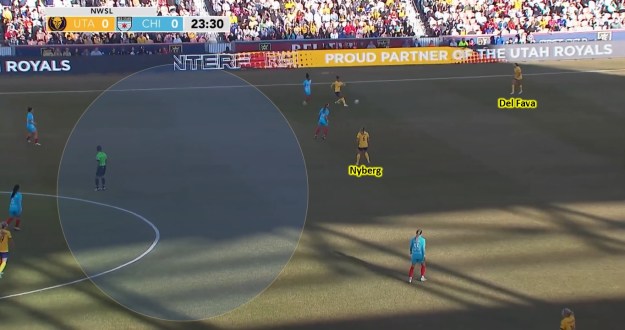
Unable to find their midfielders, Utah were often forced to go long. So it would go: pass, pass, pass, pass, pass, pass…long. Long balls can be effective, but given the inaccuracy of these, and their desire to keep passing short initially, this looked more like a last resort than anything else.
Chicago used their zonal defence to set pressing traps, where two players converged on a Utah player from different angles (winger + striker, or midfielder + striker, etc.). This meant that, even when Utah did manage to penetrate Chicago’s first line of defence and find Nyberg, she didn’t have time to think or look around and was rushed into some misplaced passes.
Nyberg did her best to find space with some quality movement. This was moving in the opposite direction to Chicago’s front two, or a short burst of speed on their blind side. Nonetheless, the connection between Nyberg and the other midfielders wasn’t quite there. Here, she buys herself some space, but can’t find more advanced teammates, turns back, and Utah are back where they started.
Utah are a new team within the NWSL, and this was their first competitive match. It’s understandable that their players are not yet on the same wavelength. Perhaps with more time playing alongside one another, there will be greater synergy between players. And perhaps the attacking players will become more confident to come short and reduce the distance for the ball from the centre-backs.
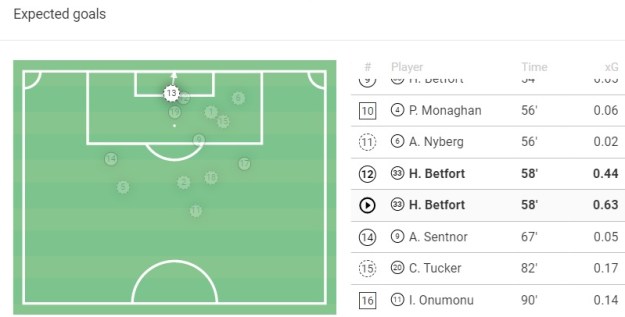
This happened on a couple of occasions in the second half of this game, with Ally Sentnor (the left winger) showing for the short ball inside-left, receiving from Riehl. In the 58th minute, she laid off to Nyberg in space (a simple up-and-back move you see in a lot of possession-based teams as they try to find a free player in midfield).
This led to a sweeping move and ultimately Utah’s best chance of the whole game, with Hannah Betfort missing from close range after a Paige Monaghan cut-back.
Credit: Wyscout
That one breakthrough moment underlined the opportunities that can come when one of Utah’s more advanced players shows for the ball, particularly against a 4-4-2, primarily zonal defence like Chicago’s. They can out-number, or combine with Nyberg. Another option to consider, particularly against more man-to-man defensive systems, would be rotations between midfielders—Nyberg moving forward and Foederer or Tagliaferri dropping back—to confuse the marking and generate a free player.
Utah showed glimpses of how they might like to play in their opening game. To turn game style into substance, they will need more movement in midfield.
Discover more from Women's Soccer Report
Subscribe to get the latest posts sent to your email.
