Can Colombia play in every game at this World Cup? I wouldn’t complain if they did.
During their Group H opener 2-0 win over South Korea, Las Cafeteras demonstrated the most fluid attack seen at this tournament so far. This will be an analysis of their front four, what they did in this game, why it was fun, and what makes it dangerous for opponents.
The Fabulous Four
Here is a brief lowdown of the players comprising Colombia’s front four, and what distinguishes each individual (in my eyes, anyway).
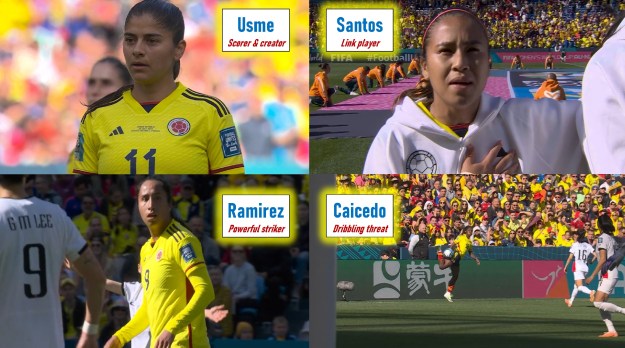
Catalina Usme
33 years, left footed, goal-scorer and creator, plays for America de Cali
Even by the high standards of fluidity seen in Colombia’s attack, Usme has a free role. She is allowed to roam not only the full width of the field, but explore depth too, sometimes playing up front, sometimes dropping down into midfield. She has a lovely left foot, capable of accurate balls to the flanks and a dangerous long-range shot. Naturally, Usme is very difficult to mark, and her movement requires defence and midfield units to communicate well and pass her on effectively. She is naturally drawn to the ball, and will wander to try and connect with teammates.
Leicy Santos
27 years, right footed, midfield link and dribbler, plays for Atletico Madrid
Santos is an attacking midfielder, given license by the holding presence of Daniela Montoya and Lorena Bedoya to roam across the field. Her primary role is that of link player. Agile, with a low centre of gravity and tight ball control, she is a sharp turner and difficult to dispossess. An intuitive player, Santos is at her best in small spaces, playing with one or two teammates close by. Of Colombia’s front four, she is least likely to score. Instead, she rotates positions with others and looks to combine with those around her.
Linda Caicedo
18 years, right footed, fast winger and 1-v-1 threat, plays for Real Madrid
One of the most exciting young players in the world right now, Caicedo is a winger who alternates between the right and left flank. She is the biggest one-on-one dribbling threat in Colombia’s attack. With a sharp turn of pace, she is also the most direct of the front four, always looking to go straight at her opponent. While capable on her left, Caicedo is naturally right-footed. Due to her speed and control, she is extremely dangerous in space or isolated against a defender, and her opponent will probably require help to deal with her.
Mayra Ramirez
24 years, right footed, powerful striker and team player, plays for Levante
At 5’10”, Ramirez is the tallest and strongest member of Colombia’s front four. With excellent control to boot, she is extremely difficult to shift off the ball and was the second-most fouled player in Spain last season, per FBref data. Ramirez has the qualities to be a focal point and play up against centre-backs, but often roams to the wings for Colombia. This is something she also does at club level.
Fluidity
Colombia’s front four interchange positions a lot. On paper, it’s 3-1: Usme is the ‘1’ up front, Ramirez and Caicedo are on the wings, and Santos drifts behind them all. Against South Korea, however, these players swapped positions. These were the various different setups I noted throughout this game:
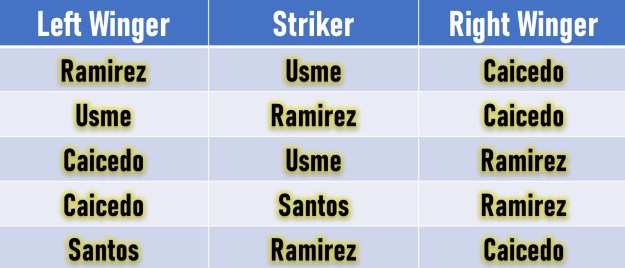
And below is a territory map courtesy of Yash Thakur which shows the fluidity of Colombia’s three ‘forwards’: Ramirez, Caicedo and Usme. As you can see, they all got plenty of touches across the field against South Korea. This graphic backs up the eye test, showing that Usme took a lot of touches in more withdrawn areas, Ramirez was the most involved in the penalty box, and Caicedo’s involvement came mostly on the wings.
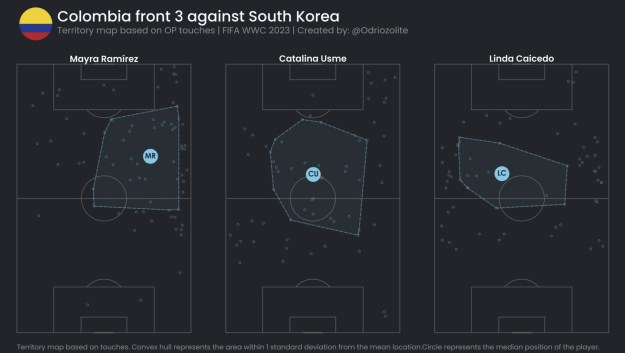
(If you like this, I suspect you will also enjoy Yash’s blog: Dribbles and Nutmegs.)
Positional Interchanges: What They Mean (With Video)
Due to the unique profiles within Colombia’s attack, these position interchanges ensured the opponent constantly had to adjust to vastly different challenges. One minute, the centre-backs were up against Usme; the next, Ramirez. Let’s look at some of the permutations.
Usme and Santos up front: Two false nines
Usme is not an out-and-out striker. She will drop into midfield and drift wide, searching for the ball, looking to open the game with a switch, through ball, cross or shot. Her wide range of movement means the opposition must communicate well to pass on marking responsibility. Ideally, she should not be allowed to turn and face play, where she can be very dangerous. Sometimes, South Korea didn’t pass on marking duties or get tight enough to Usme, so she was free to out-number and make plays.
There were brief spells during the South Korea game where Santos went up front, allowing Usme to come deeper. If Usme is the free spirit, Santos is the diligent tactician, the one who fills in for her teammate and tries to confuse the opponent. Santos isn’t a big goal threat, but she is very difficult to contain, able to twist and turn out of tight marking situations.
Ramirez up front: Hold-up play
Ramirez is bigger and stronger than Usme and Santos, more able to play up against a defender. Colombia can play in the air to her, knowing she can win the aerial battle or hold it up and lay off. If tightly marked, she is liable to roll the defender as if they were never really there.
Ramirez won the free kick that led to Colombia’s penalty kick opener, and there were numerous occasions where South Korea needed three or more players to stem her forward momentum.
Caicedo on the wing: Explosive dribbling
Whether on the right or the left, Caicedo sticks to the wing for the most part, looking to receive the ball in space and generate momentum on the dribble as she goes at her opponent.
It goes without saying that, if she is given the time and space to get going, she can shred defenders one-on-one and dramatically increase the levels of danger within a matter of seconds. On Caicedo’s first dribble after switching to the left, South Korea failed to get cover inside her direct opponent and the youngster went on to score.
Ramirez on the wing: Attracting defenders
When playing on the left wing, Ramirez is more likely than Caicedo to dribble infield and attract defenders towards her.
While it may be wise to shut down Caicedo quickly wherever possible, to stop her dribbling at the defender, the opposite is true with Ramirez. If the defender gets too tight, she is getting rolled. It makes more sense to show Ramirez wide, and get ready to turn on the jets if she tries to knock it past you.
Usme on the wing: Crossing threat
At times against South Korea, Usme drifted out to the wings. She lacks the dribbling threat of Caicedo or Ramirez, but is much more dangerous with her final ball. Her early cross is a weapon, especially if Ramirez is the one attacking it. It’s imperative that defenders don’t allow her that space to cross, as South Korea did at times.
Santos on the wing: Combinations
Santos came out to the left flank versus South Korea briefly in the second half. She is more likely to move inside and come short for the ball. In this case, the defender should focus more on the run of Colombia left-back Manuela Vanegas. Take away that space, try to delay the attack, and let Santos have the ball in deeper areas if necessary.
Making Space + Finding Space + Attacking Space
Clearly, there are a lot of permutations to consider when defending this Colombian front four. We can simplify things by looking at the tendencies of each attacker based on their relationships to space, ball, opponent, and teammates.
- Usme: Seeks the ball, wanting to dictate the attacking play.
- Santos: Seeks her teammates, wanting to combine with them.
- Caicedo: Relishes the chance to attack in space.
- Ramirez: Relishes physical tussles with opponents.
And specifically regarding space…
- Usme and Santos: Want to find it.
- Caicedo: Wants to attack it.
- Ramirez: Makes it for others.
Below is a cool graphic from the FIFA official match report, with some data that shows the different types of movement these players bring to the table.
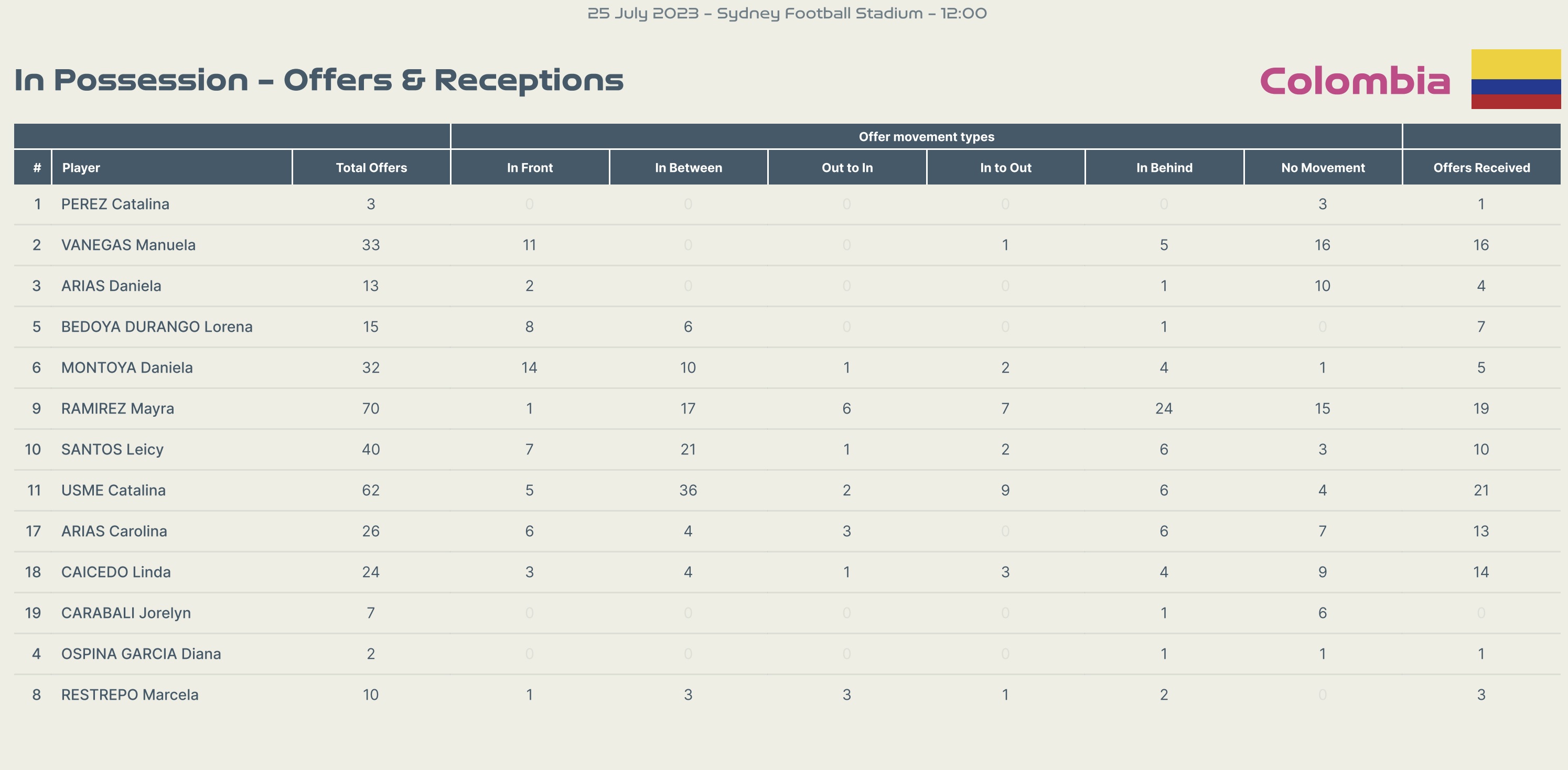
Click to enlarge (Source: fifatrainingcentre.com)
Usme offered more between the lines than anyone else, with 36 offers. Santos was closest to her, making 21 offers in between. Ramirez made 24 offers behind the defence, which is the most by quite some distance in that category. She also offered more ‘out to in’ (presumably when she was coming in from the left flank). Caicedo made fewer offers for the ball than anyone else in the front four, which underlines her role was to stay wide so her teammates could try to find her isolated one-v-one.
Rotations During Play
Karen Bardsley, commentating for the BBC: “The South Koreans are really struggling with the fluidity and the interchange of positions the Colombians are offering. Really struggling to get out to the ball quickly before the ball’s gone already.”
Colombia’s front four change positions a lot between plays, but they also rotate during play, which leads to some nice, quick combinations.
Quite often, these combinations are accompanied by a well-timed run by the full-back (Vanegas on the left, or Carolina Arias on the right).
What Next? Germany…
Colombia face Germany in their second World Cup group game on Sunday. Germany started well with a 6-0 win over Morocco, but did give opportunities to the Moroccans which were not taken. Colombia’s front four brings a lot more to the table, and they could easily get a goal or two against a German back line that has looked fragile at times.
The challenge for Colombia will be getting their front four on the ball, and in situations where they can cause problems. Germany are a powerful side with intense pressing, and may look to nullify any Colombian attacks at source. Still, Colombia don’t need to dominate possession to be dangerous, and their position swapping could befuddle Germany’s back line.
If Rauch handles Ramirez, maybe Caicedo will switch over to the right. If the centre-backs are doing well against Usme, maybe Ramirez will go up front. These are the questions that Colombia can ask of opponents, thanks to the variety and flexibility in their front four.
Discover more from Women's Soccer Report
Subscribe to get the latest posts sent to your email.
