On Thursday, England and Brazil met in the first ever Finalissima. It was a meeting of European and South American champions, but also of two great managers in the women’s game: Sarina Wiegman and Pia Sundhage. The game ended 1-1, with England eventually winning on penalty kicks. Here are the things that stood out to me.
Brazil defend 5-3-1-1, Bia following Walsh everywhere
In the first half, Brazil defended in a 5-3-1-1 that saw one striker—Bia—follow Walsh everywhere. Walsh is widely accepted as England’s playmaker, but Bia marked her virtually all the way to the dressing room. Walsh got no time on the ball and no space to play forward, so she was not able to influence the game as she normally would. She couldn’t turn and open things up with her diagonals or balls over the top.
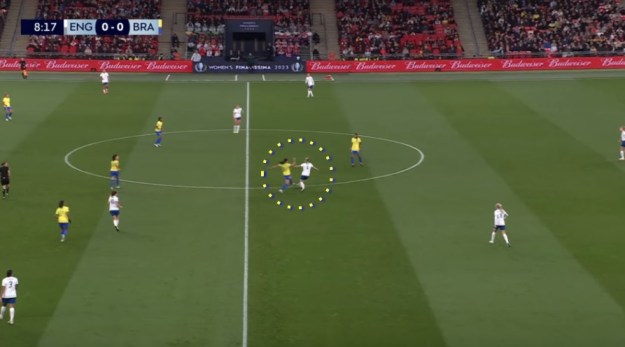
For Brazil, the downside of this man-marking of Walsh was that it left the other striker, Geyse, on her own against England’s centre-backs. Brazil’s wing-backs were defending England’s tricky wingers, James and Hemp, which left the midfield three of Ary, Luana and Kerolin with an impossible job of covering the entire width of the field. The end result was that England’s full-backs had lots of time and space on the ball.
England had easy possession along the back line, from full-back to full-back via Williamson and Greenwood. They just couldn’t get Walsh on the ball. Still, Brazil were forced to defend deep in their own half and were not able to put pressure on England’s defenders in build-up.
England’s full-backs, contrasting displays
We saw a problem with Carter at left-back for England—she doesn’t offer much going forward. Firstly, she is very right-footed, so won’t go around the outside and whip a cross in. Secondly, she is more defender than attacker, and is naturally inclined to stay back and keep things simple with her passing. England’s full-backs had a lot of freedom because of how Brazil defended, but Carter couldn’t make use of that freedom.
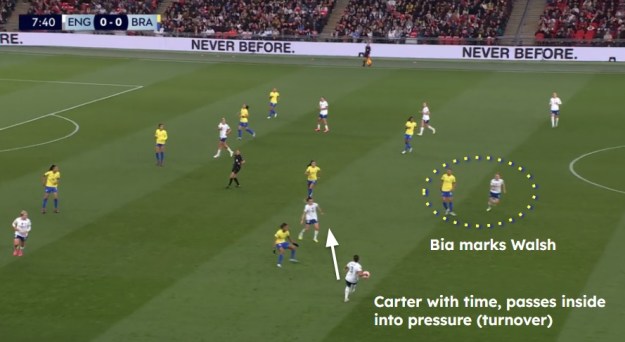
The next issue with this is it meant Hemp was isolated against Brazil’s right wing-back Antonia, who always had cover inside thanks to Brazil’s back five giving them a spare player. Without Carter running off of her, Hemp had to go it alone. Antonia bottled her up well, with centre-back Lauren covering inside of her just in case.
Bronze offered more going forward on the right side, overlapping James, combining with the midfielders and getting into the box or hitting the by-line to cross, like she did for England’s goal. Carter is just a different profile of player—a centre-back in a three, or a defensive full-back for special situations.
In the second half we saw another issue with Carter at left-back—predictability. Without a left foot to go down the line, her inclination to pass inside or backwards was taken advantage of when Brazil went to a 4-4-1-1 and pressed higher. She had less time, made some poor passes under pressure, and invited Brazil on.
Managers can’t ask players to become different players overnight. All of them have their strengths and their weaknesses. Left-back has been a problem position for England for a while, there is no obvious solution other than to build leeway into the game plan (i.e. make sure players are showing inside for Carter when she’s under pressure; make sure Hemp gets support runs from someone else, like Russo or Toone…).
Behaviour of the Brazil back 5: aggressive marking, holding the line, transitions
Brazil defending in a back five meant a 5-v-3 on England’s front line of James-Russo-Hemp. With spare players, Brazil chose to aggressively mark England’s forwards. This prevented Russo from being able to turn and shoot, something she does very well from outside the box. It also limited the space of James and Hemp to get momentum going at their opponent, and ensured cover inside if the wing-backs were beaten. Antonia on the right side did a particularly good job of controlling Hemp.
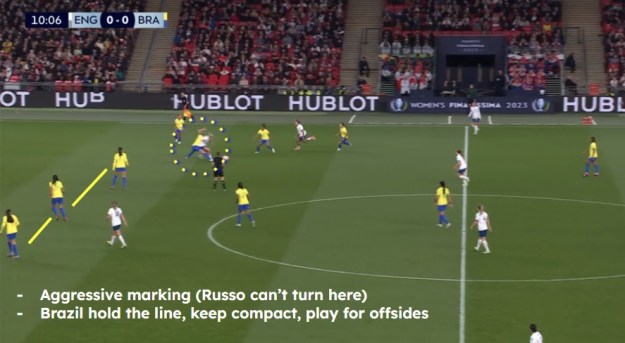
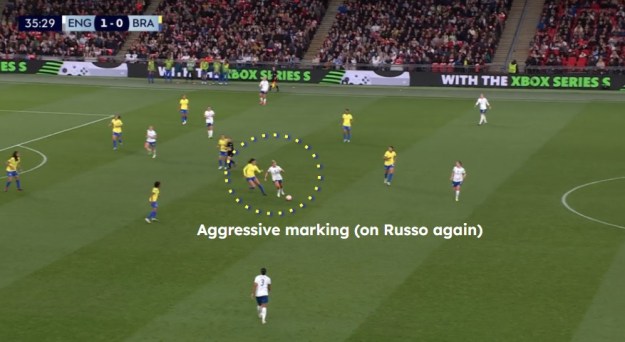
Along with aggressive marking on England’s front three, Brazil tried to hold their line. 1) They made sure to reduce space between the defence and midfield, meaning less space for Toone etc. to do damage. 2) They tried to force England’s forwards into offside positions. (2) was particularly noticeable in transition. A few times where England looked to break away, Brazil’s defence held the line, not dropping back, to catch James, Russo etc. offside.
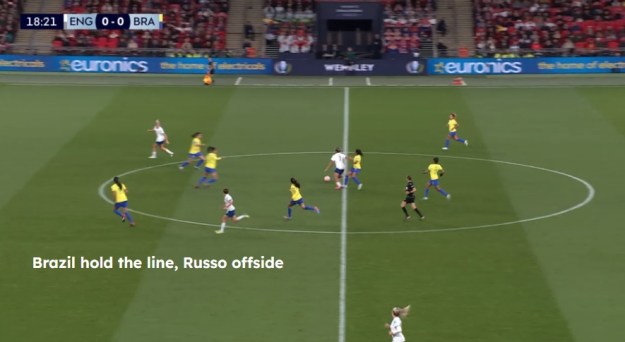
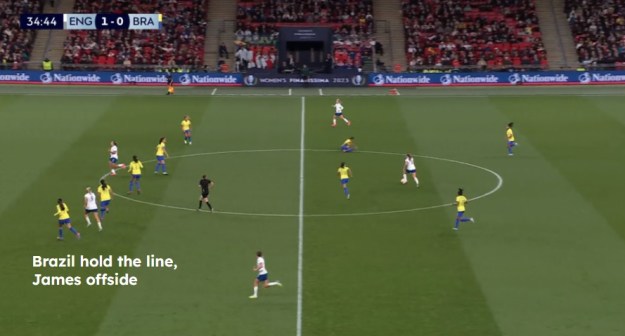
It’s one thing to get the line spot on and catch strikers offside, but what happens if it doesn’t work? Well, Brazil’s defenders have the pace to recover position, catch up and compete 1-v-1. Rafaelle, Kathellen, Antonia in particular. The Brazil back line were good collectively, but also could handle themselves individually when they needed to.
Brazil change formation in second half
For the second half, Brazil took off a defender (Lauren) and brought on a forward (Adriana) and defended in a 4-4-1-1 formation. Andressa Alves replaced Bia and took on her man-marking job on Walsh. Adriana played on the left wing, with Ary on the right. With four across midfield instead of three, Brazil got quicker pressure on England’s full-backs and forced some mistakes (already mentioned Carter’s predictability under pressure inviting Brazil to press higher and win the ball in England’s half).
This didn’t mean Brazil dominated the ball and England gave it away all the time, but England had to build possession from deeper in their own half and went long more often, looking for the runs of Russo and Hemp particularly. But as mentioned, Brazil’s defenders had the speed to keep up with them, if they couldn’t catch them offside in the first place.
Brazil individual switching off = opportunities to England
Sundhage has done a good job of making Brazil more defensively organised, specifically with regard to compactness, work rate from the front and defending as a unit. However, there are still times where individuals switch off. This presented some opportunities for England.
There was the England goal, which is largely the consequence of Brazil’s midfield not reacting in the moment. As the back line drops to defend a potential cross into a dangerous area, the midfield does not follow suit. Space opens up between the lines, for Stanway to play in Bronze, and for Toone to finish the cut-back.
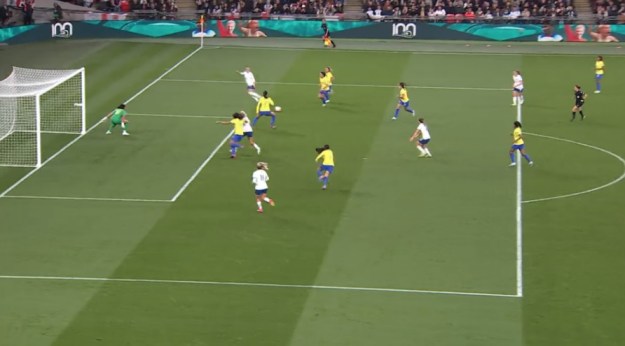
Another moment later in the second half, where Kerolin marks up the opponent in her zone (Bronze had moved inside). Only Luana, the other central midfielder, did not move over to keep the midfield compact. There was a gap for England to play through.
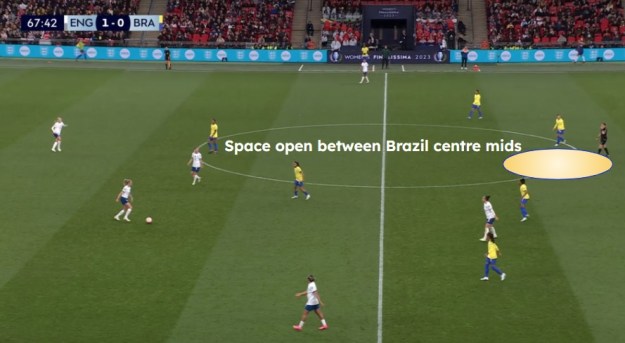
These were simple cases of individuals switching off in moments and leaving gaps for the opponent to exploit. Little details, but they can make a big difference.
England don’t keep ball in transition
On the whole this was an even game, albeit one in which England dominated the ball. Both teams had their spells. England asked questions of the Brazil back line in the first half simply because of how much possession and territory they had. In the second half, Brazil won more balls in England’s half, and Geyse could shine.
Mainly this was a case of Brazil defending in two different ways, and posing different challenges to England, only to be undone now and again through individual errors. There wasn’t a lot of new information gained regarding England. The only new issue to emerge was giving the ball away early in transition way too often. These were cheap giveaways as a consequence of poor individual decisions or sloppy passes. Still, these allowed Brazil to counter-attack, with Geyse and Kerolin extremely dangerous 1-v-1. Both with a drop of the shoulder, a feint or a change of pace to go past their opponent.
Summary of what we learned
- Brazil can defend well in a back five
- England’s right (Bronze+James) looks more dangerous than their left (Hemp)
- Brazil hold the line well and can play for offsides
- Brazil’s second half may look a lot different to their first half
- Brazil’s defensive compactness can be undone by individuals switching off
- England need to keep the ball better in transition
Discover more from Women's Soccer Report
Subscribe to get the latest posts sent to your email.
