The aim of this post is to highlight the different types of runs that footballers can make, and in what ways these runs can enhance an attack. Along the way I will show examples from several top players in the women’s game, some of whom have built careers on their movement. Before we get into all of that, a brief consideration of the characteristics that so often define these players.
Intelligence is something that gets mentioned a lot, these players are ‘clever runners’ who anticipate the play unfolding around them. But there are other important aspects. Timing and speed are vital. Work rate is key as well. It’s rarely the case that a player makes one run to score one goal—usually, the goal is a consequence of constantly making runs, and eventually being found. Just ask Gary Lineker, who once said:
If I make 15, 20 of those runs in a game and the ball comes to me once, and I’m all on my own, two yards out from goal, everybody will say ‘well, he’s in the right place at the right time’, but the answer is to be in that place all the time, then eventually when the ball does come to the right place, you’re there.
I’ve separated the various different forward runs into three sections below.
- Runs behind a defence
- Support runs
- Runs in the penalty box
RUNNING BEHIND
Attackers are always looking for ways to get into the space behind a defence, to try and create one-on-ones with the goalkeeper, or other dangerous situations. There are a few different ways to find that space.
Running off the shoulder of the centre-back
This is the kind of run you typically see from strikers. Lingering on the shoulder of the last defender, waiting to sprint in behind them. The striker must be patient and hold the run, not go too early and get caught offside. They might ‘bend’ their run to stay on. They also need some acceleration—starting the run on the same line as the defender, they must be quick enough to beat the defender to the ball.
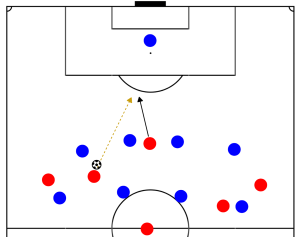
Running diagonally behind from wide
You often see these runs performed by the wide players in a front three. As the ball is being moved towards their flank, they can run behind the opposing full-back. The full-back has to keep an eye on the ball and stay connected to their centre-backs, so the attacker has one big advantage in that they are running on the defender’s blind side.
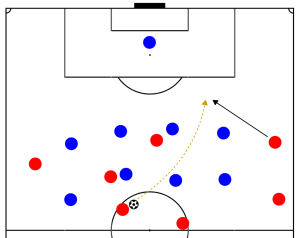
Running the channels
The channels are the spaces between the opponent’s centre-backs and full-backs. These spaces are always there, but tend to open up as the opponent applies pressure on the ball side, leaving a gap for strikers to run into.
Running the channels is a way for the striker to offer their team an option over the top. It can relieve pressure, put the opponent on the back foot, and also drags a centre-back into a wider area, opening space in the defensive line and taking (probably) one of the opponent’s best headers of a ball away from the box should a cross be worked in.
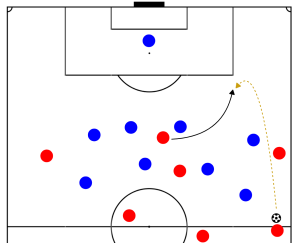
Arsenal and Sweden’s Stina Blackstenius possesses superb movement, and is probably the best at running the channels. She’s alert to the space opening up, possesses good pace, and makes it clear that she wants the ball.
Runs from deep
These runs are usually performed by midfielders—players who are not directly up against a defensive line, but close enough to run behind it when the opportunity arises. These runs are difficult to cover, because they usually go through two lines of defence (the opponent’s midfield and back line). This can leave defenders confused as to who should pick up and unable to switch marking duties in time.
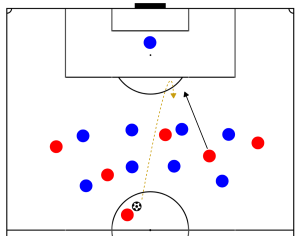
There is a likelihood that the centre-backs are pre-occupied by a forward or two, so may not be able to cover the run from deep. Another benefit is that, because they start from a deeper area, the runner can gain momentum and hit top speed, while the defenders are having to react and adjust.
Aitana Bonmati of Barcelona and Spain is a fine example of how dangerous runs from deep can be. She constantly makes these runs for club and country, and regularly gets chances as a consequence.
SUPPORT RUNS
It isn’t just forwards and attacking midfielders who can contribute to the attack through running behind a defence. Those elsewhere on the field can support the attack through runs in various ways.
Overlaps and underlaps
These runs are traditionally executed by the full-back or wing-back, attacking the space outside (overlap) or inside (underlap) their teammate on the flank. The key is knowing when to join in—timing the run can surprise the opponent and exploit space that they have not yet adjusted to cover, or out-number them on that flank.
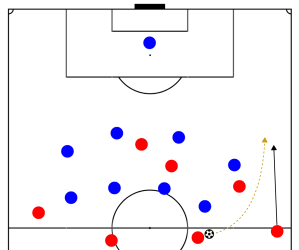
Overlapping is done to get in around the outside of the opponent, often to get into crossing position. Underlapping means running inside the opponent’s defensive structure, often to get more involved in build-up play or even support the striker. Both runs can take defenders with them, in the process reducing cover of a teammate, giving them more space to play with.
Ellie Carpenter of Lyon and Australia is probably one of the most consistent suppliers of these runs. Exceptionally quick and a fantastic athlete, she can cover the entire flank on her own, always offering her team an option on the right side.
Other good examples worth mentioning are Lucy Bronze and Fridolina Rolfo (when she’s playing left-back for Barcelona). Bronze is powerful and possesses a dangerous enough shot to threaten if running infield, while Rolfo’s overlaps allow Mariona Caldentey to drift in and out-number the opponent centrally. These runs are often selfless—the runner won’t necessarily get the ball, but still helps their team.
Running off the striker
These runs are often performed by midfielders and called ‘third man runs’, because the runner isn’t initially involved in the play. Player 1 is the passer, Player 2 the receiver. The ‘third man’ is looking for the next pass.

Whatever you want to call them, these runs challenge the focus and work rate of opposing midfielders, who may not want to track back, or be drawn to the initial passer and receiver. That means the runner, the ‘third player’ can get free to latch onto lay-offs, knock-downs or flick-ons from the forward.
When done as a part of quick passing moves, these support runs can be devastating. Grace Geyoro’s third goal for France against Italy at EURO 2022 is a good example. As is Adriana Leal’s penalty-winning run for Brazil against Argentina at the 2021 SheBelieves Cup.
RUNS IN THE BOX
Once an attack is established, runs in the penalty box are vital. It’s important that attackers don’t get in each other’s way, cluttering space, or simply stand still and hope their marker switches off. Here are some of the different runs attackers can use to work shooting opportunities in the box.
Attacking the front post
When a cross is about to be played into the box, there is value to be had from attacking the front post. If the attacker gets in front of their marker, they have a good chance of being first to the ball and working a shot on goal. These runs are often made by the striker, as the attacking team’s first entrant into the box.
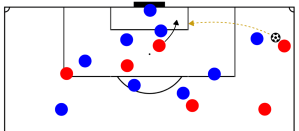
Timing is key. If the attacker gets to the front post too early, the defender can see both them and the ball, making it easy to mark up, intercept the cross or block the shot. On the other hand, if the attacker is too late, the defender will likely be all over the clearance. It’s also worth noting that these runs can act as a decoy. Even if the attacker doesn’t get on the end of the cross, they can drag a defender with them and open space elsewhere in the box for teammates to finish.
These runs were Ellen White’s bread and butter. Any young striker wanting to learn more about penalty box movement would be wise to watch footage of the former England and Manchester City striker. Without remarkable pace or height, White consistently got on the end of moves before her defender. She got plenty of goals at the front post, combining her run with incredible reactions and flexibility to make some kind of contact and deflect the ball goal-wards.
Marie-Antoinette Katoto is another good example. At the 2022 Tournoi, she demonstrated movement to beat defenders to the ball at the front post, not to mention the sort of ingenuity to work a shot from strange angles that White built a career on.
Double runs
How can an attacker get in front of their defender on crosses? One way is to make a double run. This is a simple but effective principle for attackers to follow—make one run for the defender, and another for yourself.
The defender wants to mark you, so will follow your initial move. Lead her one way, so you can attack the other. This is a way for attackers to separate themselves from a marker—to get to the front post first, or to generally make space for themselves.
Attacking the back post
If the front post is usually the striker’s domain, the back post regularly belongs to the far-side winger. This is often a case of hunger to score—a lot of wingers don’t make these runs, because they don’t think the ball will make it that far. The idea is to gamble in the knowledge that, every now and then, the ball will arrive there to be finished.
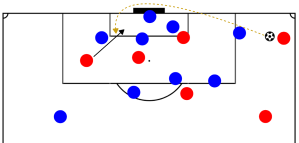
Defenders will be drawn naturally towards the ball, so the back-post attacker will have the advantage of seeing both their marker and the ball coming in. The back-post attacker also benefits from (1) having a bit more time to adjust to the delivery, and (2) being able to see the whole goal. And if the angle is too tight to score, they can always re-direct back across goal for a teammate.
Again, it’s key not to arrive early. Get across the defender at the last possible moment so they can’t see the run and mark up. Lauren Hemp of Manchester City and England is particularly good at this. While renowned for her dribbling skill, a significant portion of her goals come simply from being on hand to attack the back post.
Late runs
These runs are often made by attacking midfielders, because they arrive in the penalty box later than the strikers. Defenders’ first instinct will be to defend the front post to prevent tap-ins. One will usually cover that and try to intercept the cross, while the others form a line behind them to defend the goal. This leaves space between the defensive line and the edge of the penalty box.

If the opposing midfielders aren’t switched on to track runs, the attacking midfielder can arrive free near the penalty spot. They frequently have more space than the forwards attacking the posts, and are also in a position to score on rebounds. Alexia Putellas of Barcelona and Spain scores a lot of goals from late runs.
Discover more from Women's Soccer Report
Subscribe to get the latest posts sent to your email.
