Paris Saint-Germain had their French title hopes dented when they drew 4-4 away to FC Fleury last Friday. The scoreline, a missed Bachmann penalty, and the fact PSG had 78% possession, might lead some to the conclusion that PSG found themselves unfortunate, that they fell victim to the unseen forces that so often stop them in their tracks. The truth is that Fleury—despite the goals conceded—put up a strong defensive fight, using some clever strategies to exploit weaknesses in PSG’s build-up play.
All four of Fleury’s goals came from attacking transition. Of course there was some outstanding individual skill involved (as you can expect from a team featuring Kouassi and Le Garrec), but a lot of their attacking threat originated from a solid, well-organised pressing game. Let’s get into it.
Kouassi, Kamczyk and Fleury’s pressing traps
Precheur lined PSG up in a 4-3-3, with Fazer, Diani and Bachmann acting as a narrow front three in attack. Abriel lined Fleury up in a classic flat 4-4-2. They defended zonally, not putting pressure on PSG’s centre-backs. Instead, their pressing started when PSG 1) attempted to find someone between the lines, or 2) played out to their full-backs on the touchline.
Fleury’s front two of Kouassi and Kamczyk put in an excellent defensive shift. The nearest one would move towards the PSG centre-back in possession, not really rushing them, more improving their chances of winning the ball on a bad touch. They angled this movement to also block PSG’s base midfielder Jean-Francois. The other striker would simultaneously come over and mark Jean-Francois. Kouassi and Kamczyk moved together as if connected by a piece of string, and never switched off.

Geyoro helps to keep PSG possession ticking.
PSG reacted to this with Geyoro dropping back to pick up the ball in space to the side of Kouassi and Kamczyk. She moved on the blind side of Fleury’s strikers, so they didn’t see her coming and couldn’t adjust to block her.
Fleury’s midfielders didn’t want follow her all the way, because that would give up space between the lines for Bachmann/Diani. This bought Geyoro some time on the ball, opened space for Jean-Francois and helped PSG to move the ball around securely while looking for a route forward.
However, while Precheur’s side were able to circulate from one side to the other, they found it difficult to move forward through the middle. Despite having a narrow front three looking for space in-between, the centre-backs couldn’t find them because of Fleury’s compact midfield four. Whenever Diani and Bachmann did receive the ball, Fleury converged on them—a ‘pressing trap’, ‘doubling up’ or whatever you want to call it. The midfielders would converge, and even Kouassi and Kamczyk were ready to help back and reduce the options.
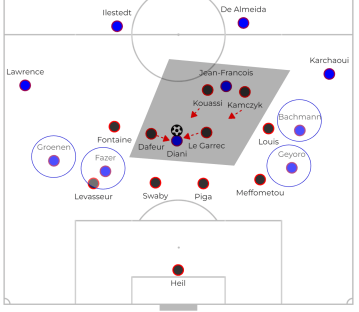
Fleury converge on Diani & PSG lack structure to combine in centre. (Look where the other attackers are!!!)
Another issue for PSG was self-inflicted—because of Geyoro and Groenen moving beyond the ball, the receiver lacked lay-off options. Jean-Francois was often double marked by the Fleury front two. So Diani would receive but have no time and no open lay-off.
Fleury’s pressing traps had a knock-on effect in transition—when they tackled or forced a mistake from the receiver, they had three or four players close to the ball, whereas PSG only had one or two. Fleury were set up to seal possession and start their counter-attack. This is precisely how their second goal originated (see image below).
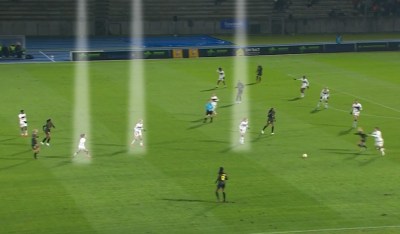
Groenen is about to be tackled. Fleury have 3 players ready to secure ball in transition (L-to-R: Fontaine, Kamczyk, Dafeur).
A lot of PSG’s attacking movement was vertical—up, down. There wasn’t much rotation between players, and it was easy for Fleury’s defenders to mark up. With help from a compact midfield and two hard-working strikers, Fleury could then secure the ball in transition, combining to start a breakaway.
PSG get stuck on the wings
Although PSG had lots of possession, they were allowed this to an extent by Fleury’s defensive setup. The problem for PSG wasn’t that they gave away the ball too many times, it was that on those occasions they did give it away, they were in danger. Fleury’s compact shape made it tough for PSG to play through the middle. So PSG had to go wide a lot, to full-backs Lawrence and Karchaoui.
Passes to the PSG full-backs triggered Fleury to press. As an example, on their left side, the winger would quickly close down Lawrence while blocking the diagonal pass inside, the full-back would mark Fazer, and the nearest central midfielder would cover behind or mark another option. With the lack of rotation or varied movement from PSG, it was easier for Fleury to mark up and see the ball in these situations. Meanwhile, Kouassi and Kamczyk continued to follow Jean-Francois around, ensuring she was marked even when the ball was on the touchline, reducing the PSG full-back’s open inside passing options to nil.
Again PSG’s attacking structure played a role in their own downfall. Yes, at times Geyoro came deep to receive from the centre-backs, but then she would turn and run back upfield. Most of the game, PSG had Fazer, Groenen, Geyoro, Diani and Bachmann all ahead of the ball. With Jean-Francois marked, there just weren’t any easy options for Lawrence and Karchaoui to combine with.
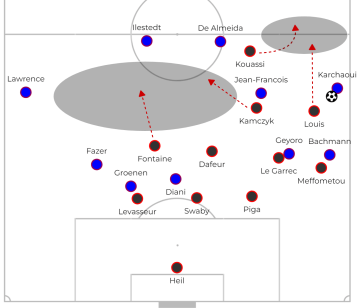
Huge spaces in PSG build-up structure, which Fleury can attack in transition…
Adding to the risk, if Jean-Francois did come all the way across to help, that meant vacating the centre, leaving huge space for Fleury to counter-attack through. With Lawrence and Karchaoui on the flanks, PSG would effectively have just two players behind the ball in these moments. Against a side with a lightning quick dribbler in Kouassi, with good support from Louis, Fontaine and Kamczyk all ready to burst forward in transition, that’s trouble.
There were times where PSG could out-play this pressure on the touchline through individual skill. Groenen wriggled away from Fleury’s left-back, Levasseur, to work a cross in from the right flank, which indirectly led to PSG’s second goal. But for the most part Fleury’s pressing on the wings isolated Lawrence and Karchaoui, forced PSG to reset play with their centre-backs, or forced a turnover and a dangerous breakaway opportunity for Kouassi and co. Karchaoui ended up having a particularly bad game, with several poor touches and a loose cross-field pass that opened things up for Fleury to score their third.
Conclusion
PSG dominated the ball and created more opportunities in this game. Had Bachmann converted her penalty to make it 5-2, things may have looked a lot different. But it’s fair to say that Fleury have no right to be competing with PSG, and scoring four goals. It’s also fair to say that they created consistently on the counter-attack, thanks to a combination of good defensive shape and pressing strategies, combined with PSG’s openness in build-up.
The fluidity of PSG’s attack has caused defensive issues before for Precheur, and something he needs to remedy if PSG are to hold off an energised Lyon in the second half of the season, not to mention compete in the Champions League. As for Abriel, he described the draw as being ‘like a victory’. His Fleury side are now 4th in Division 1, just two points off Paris FC and the dream of Champions League qualification.
Discover more from Women's Soccer Report
Subscribe to get the latest posts sent to your email.
