Manchester City drew 1-1 with Aston Villa in a result that damaged their hopes of Champions League qualification. City are now five points behind Manchester United and Chelsea, and two behind Arsenal, who also have a game in hand.
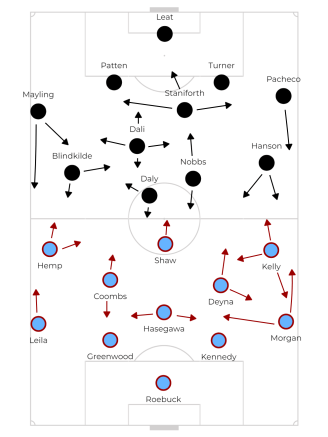
For Villa, this performance showed how big the January signings of Nobbs and Staniforth could be. The latter was particularly influential in this game, playing at the base of midfield.
Ward set her side up in a 4-3-3 with Staniforth holding, Dali playing box-to-box and Nobbs higher up to support the striker Daly. City lined up in their usual 4-3-3, with no major talking points regarding their selection.
Villa nullify static City build-up
Aston Villa set up defensively in a 4-4-1-1 zonal defence, albeit with Nobbs playing a man-marking role. She did a good job of staying close to City’s deep playmaker Hasegawa, limiting her influence and forcing City to look for other options in their build-up. Villa’s ball-side winger took a narrow position to help reduce space through the central areas and force City wide. Mayling and Pacheco were then responsible for stepping out of the back line at the correct moment to pressure City’s full-backs.
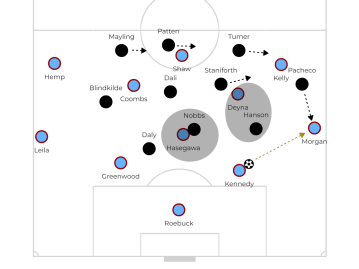
Nobbs marks Hasegawa. Hanson narrow to force City wide. Pacheco then closes down Morgan.
City tried some positional rotations in the first half, without much success. These happened exclusively on the right side—between Morgan, Deyna and Kelly. These rotations had little impact on Aston Villa for a couple of reasons. One is that they were too slow, so each Villa player could easily pass on marking duties and retain their shape. Another issue for City was that the rotations put players in areas they didn’t appear comfortable in.
Morgan didn’t find space coming into midfield. Theoretically, City could have overloaded Villa’s first line of defence 4-v-2 to build out through the centre, but Daly and Nobbs had a simple job—standing in front of Hasegawa and Morgan, then closing down the centre-backs when they tried to drive forward. There also wasn’t much benefit to be had from Kelly or Deyna playing in the right-back space.
City found it difficult to play through their midfield throughout the whole game, with a lack of quality movement. This has been a recurring issue in recent years, where the midfielders simply move towards the centre-back in possession and bring extra pressure to the ball with them. Hasegawa was the only midfielder not moving in straight lines at one pace, but she was also well-marked by Nobbs.
Ultimately, this meant City bypassed midfield a lot, looking directly for Kelly, Shaw and Hemp with hopeful long passes. They relied heavily on their front three to control these balls under pressure, then making something happen with their individual skill.
Villa’s pressing strategy, combined with City’s lack of quality movement in midfield, forced City to go more direct and they were unable to control the ball as they normally like. They ended the match with 52% possession, a smaller share than they are used to (60.8% is their season average—the WSL’s highest). Villa were their equals, and actually moved the ball more effectively too.
Staniforth key to Villa possession
Villa’s January additions of Nobbs and Staniforth led to the question of how Ward would fit them into a midfield three with another creative player in Dali. Early indications are that the solution is Staniforth at the base, with Nobbs higher up where she can make dangerous runs behind defences. Dali gets to float between the two, finding space, keeping the ball under pressure, driving play forward.
Taylor set up City in a 4-5-1 defensive shape, pressing high with striker Shaw supported by the attacking midfielders. Deyna and Coombs were often the ones to apply pressure to Villa’s centre-backs, with the closest one stepping up while Hasegawa filled in for them. Taylor may have chosen this strategy so that his wingers could stay back to control the threat of Mayling and Pacheco, who both like to get forward and put good crosses in.
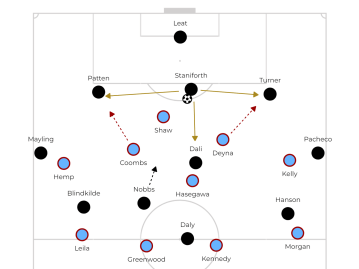
Staniforth drops between the centre-backs, helping Villa retain possession.
Villa were able to retain the ball under pressure, mainly thanks to the movement of Staniforth. She not only moved in front of the centre-backs to offer an option, but dropped in-between them or to the sides to make a 3-v-2 against City’s high press. This helped Villa to circulate possession along the back line and gave them more time to set up an attack.
Another important factor in Villa’s possession game was the position and movement of Nobbs. She would start in support of Daly, able to run behind or drop into midfield. When she dropped in, the City midfielders didn’t always see her coming. If Deyna and Coombs weren’t covering properly, Nobbs could join Dali to out-number Hasegawa 2-v-1 and give Villa the option of building up through the centre with the ball on the ground. This didn’t happen often enough, however.
There was a lot of fluidity in Villa’s midfield, but generally Staniforth stayed close to the centre-backs and Nobbs stayed close to Daly. As a consequence, Dali was mostly on her own in the middle. That made it difficult to play through midfield. So while Villa were able to control possession, Patten, Turner and Staniforth usually went wide to the full-backs or pinged the ball over the top for a runner: Daly, Nobbs or Hanson. In the second half, Lehmann came on and offered another direct option to hit the space behind City’s high line.
Key takeaways
This was a game where Villa’s defence and possession won the day. City’s build-up play was too stagnant, with not enough quality movement. Taylor also made like-for-like subs, suggesting a lack of solutions once Plan A was nullified. City only threatened consistently in transitional play, when their front three came unstuck with a bit of skill or a lucky bounce and could drive at Villa’s defence.
Villa’s new signings look set to help them make the evolution from a cross-heavy attacking side to one that can control games more with the ball and benefit from more creative movement and passing from midfield. Staniforth can help to set the tempo, while Dali and Nobbs had a lot of freedom here. They will be fun to watch, and should help Villa become a more rounded side.
The next step for Villa’s new midfield will be to find some more structure. There were a few too many times where they couldn’t find one another because they were disconnected. That meant Villa couldn’t play through the lines and had to go wide or over the top. (Their goal came from a cross-in.) Once the midfielders are all on the same wavelength, Villa should be able to go from controlling possession to playing through the lines more often.
For City, there wasn’t a lot to be positive about. Their build-up was largely nullified, and their own pressing couldn’t deal with the movement of Staniforth, enabling Villa to enjoy plenty of possession. City’s goal did show the potential of a Shaw/Deyna partnership, with the former’s hold-up play and the latter’s runs. For them to play closer together, though, Taylor will need to move away from his preferred 4-3-3 and implement a 4-2-3-1 or 4-4-2 system.
Discover more from Women's Soccer Report
Subscribe to get the latest posts sent to your email.
