Kansas City Current were the most improved team in the NWSL this year. They went from bottom of the league with 0.67 points per game in 2021, to fifth and a playoff spot with 1.64 points per game in 2022. This upswing came alongside a completely unique playing style that captured the imagination of supporters and neutrals alike. In this article I will analyse the tactics behind the Current’s success.
Before we get to that point, a bit of background to this season. Kansas City opened a new training facility, built specifically for the women’s team in June. They also moved stadiums, from Legends Field to the higher-capacity Children’s Mercy Park. Their average attendance has risen by just under 3,000, generating a better atmosphere at home games.
Along with improved conditions for training and playing, a new head coach was appointed in Matt Potter. The interview process involved input from players. “He came into that interview with…confidence and knowledge about the game that was impressive to us,” said team captain Desiree Scott. “He…had his plan and principles in place. He just seemed very organized and passionate about the game, which…was what a lot of us players were hungry for.”
In pre-season interviews and press conferences, Potter spoke less about tactics and more about ‘culture’ and ‘environment’. The team had a one-month training camp at the IMG Academy in Florida which, by all accounts, was physically demanding. The initial focus appeared to be targeting small, achievable improvements, fostering a good team spirit, and ensuring the players were physically well-prepared for the season ahead. Tactically the season was approached with an open mind – the Current started out in a 4-4-2 before eventually finding form in a 3-5-2.
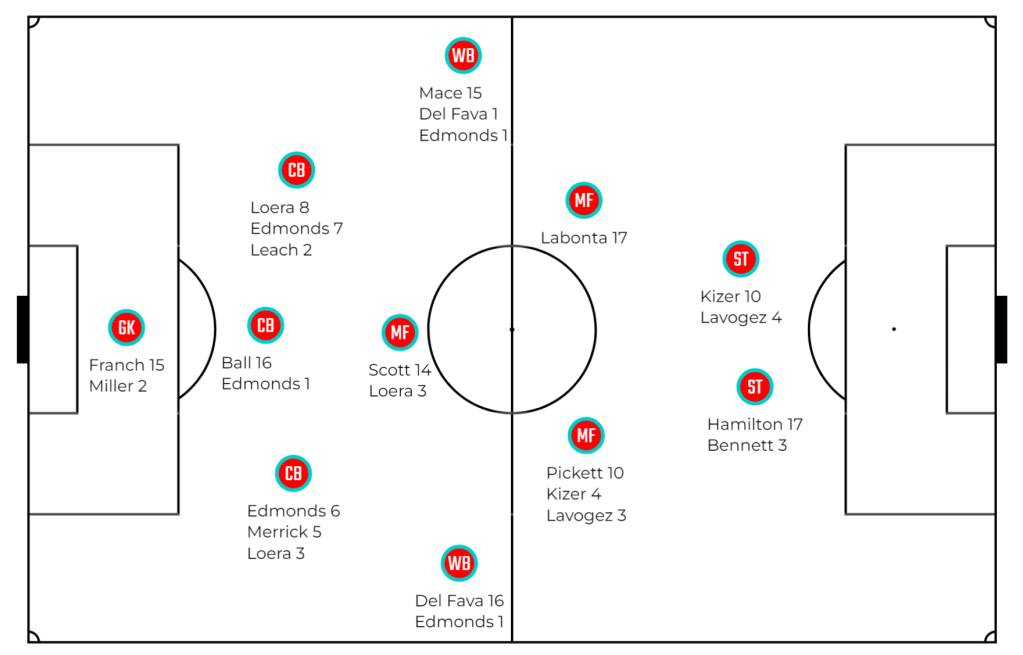
Within that system, there are some key players. Goalkeeper Adrianna Franch, centre-back Elizabeth Ball, holding midfielder Desiree Scott, attacking midfielder Lo’eau LaBonta, wing-back Hailie Mace and striker Kristen Hamilton have been crucial throughout the campaign. Victoria Pickett played an important role before her move to Gotham in August. Cece Kizer and Claire Lavogez both joined mid-season and settled in quickly.
Below is an overview of the 3-5-2, and the number of starts made by players in each position since changing to this system.
Insight into Kansas City’s coaching style
The quotes I highlight below are from Meg Linehan’s interview with Kansas City Current head coach Matt Potter, for The Athletic. I recommend you give it a listen. It gave a unique insight into Potter’s approach to developing the team’s tactics this season. Here’s the link.
“People say to me ‘are you in this formation or that formation’ and my answer’s like, ‘sure, that’s what we’re in, sure’. We give [the players] the autonomy to solve things on the field. They always have that autonomy to manipulate shape and position to try and gain an advantage or to put themselves in a position to minimise the space of an opponent or the time the opponent has on the ball.
“Out of that autonomy we do have…some principles. Within those principles, it’s again giving the players the autonomy to figure out [for example]: is this the right time to be 1v1? Is this the right time to try and overload wide, or overload centrally? Is it the right time to…drop our forward line a little deeper to compact the lines to create less space for the opponent?
“My job has been [simplifying] what is so complex and in a short period of time [giving the players] an identity that, one, gives them autonomy, and two, highlights the players that we have. It’s putting them in a place where we feel they can have the most impact…The placement of personnel is probably where we try to guide it a little bit.”
This perhaps explains why Kansas City took a while to get going this season. Obviously injuries to key players like Lynn Williams and Sam Mewis played a part, but also this coaching style isn’t necessarily geared towards a fast start. It isn’t about instructing and drilling patterns of play until players know them like the back of their hand. Rather, it sounds almost like guided self-learning, allowing players leeway to make decisions on movement and passing, and developing their ability to make those decisions.
This process would likely be a more natural, gradual one, but that can mean early losses while the players get used to each other and build up their confidence making decisions. Potter’s coaching style does appear to involve deciding which players play where tactically speaking, but beyond the basic formation and principles the players have autonomy to express themselves and develop their own patterns (perhaps via training, trial and error during matches, and through discussion, with one another and with the coaching staff).
Brief observations on Kansas City’s principles
Potter mentioned that, while the formation can change and the players have autonomy, he has sought to instill some principles within the team that guide how they play. While he has yet to elaborate on what those are, I can take a guess at them having watched most of the Current’s games this NWSL season.
- Play at a high tempo. Their first thought is to attack, particularly early in games. They don’t often get their foot on the ball, control the game, and slow it down, but instead look to go for the jugular quickly: forward with the first pass, hit space behind if possible, get runners in support. They also counter-attack a lot, and have real pace up front.
- Fluid attacking shape. There is a lot of movement and rotation among the front 6 (2 strikers, 2 attacking midfielders, 2 wing-backs). Defensive midfielder Desiree Scott and the 3 centre-backs ensure a stable base for those further forward to move freely. Off-the-cuff movements, individual problem-solving, and in-game positional adjustments are recurring themes, all of which make Kansas City hard to predict.
- Counter-pressing. When their attack comes to an end, there is exceptional commitment to get pressure on the ball and nearby passing options, to try and regain the ball as quickly as possible or to nullify the opponent’s counter-attack.
- Flexible man-marking in midfield. This is used in every game, often to disrupt the opponent’s short passing or force turnovers high up the field. This forces a lot of long balls from the opponent, and feeds into the chaotic, end-to-end feeling in most Kansas City games. (They seem to enjoy this chaos more than their opponents, who tend to want a more controlled, organised game.)
I watch NWSL, WSL and other major European leagues, A-League games from Australia and the big international competitions. I cannot think of one single other side that plays like this Kansas City Current team. As far I am concerned, they are unique at the highest level of the women’s game. The closest comparisons might be in the men’s game, with Gian Piero Gasperini and Marcelo Bielsa’s teams (back three, man-marking, high pressure, quite chaotic).
It’s a style of play that requires complete buy-in from the players, not to mention exceptional fitness levels. It’s therefore quite interesting that Potter and his staff have been able to implement it using what sounds like a more democratic coaching style. It’s also impressive that the starting lineup has revolved around the same 14-to-15 outfield players: with a playing style of this intensity, more injuries and personnel rotations would be expected, particularly as the season wears on. That Kansas City have been able to stick consistently to the same lineup is a testament not only to the players, but to their fitness and medical staff.
Now let’s analyse the Current’s tactics.
Attacking patterns, strengths and weaknesses
A flexible attacking team, Kansas City mix their build-up between patient and direct. When they try the short passing game, the ‘autonomy’ mentioned above is seen on the field. The ball is circulated between the centre-backs and defensive midfielder. There is movement from the front six players to try and make passing angles. Sometimes an attacking midfielder will drop in next to Scott, at other times, they might rotate with the wing-back, or pull into space outside while the wing-back pushes up. Kizer may withdraw to try and find space between the lines, or she may come out to the left wing while Mace runs inside of her.
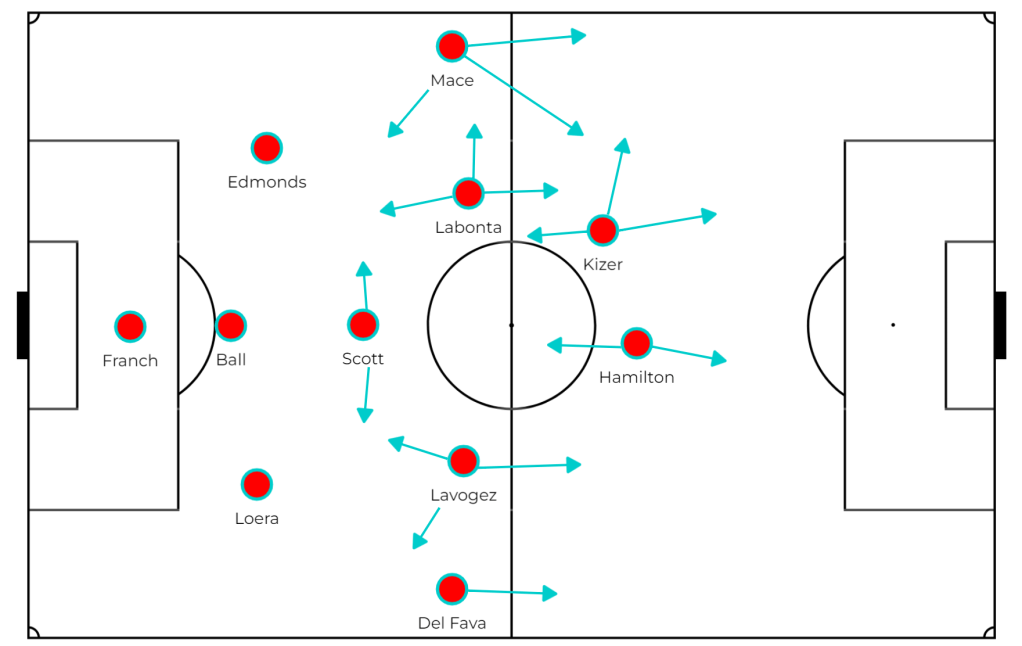
There is clear emphasis on individuals making decisions, with freedom to move and pass as they interpret the play. On one hand this makes Kansas City difficult to predict, as their build-up structure changes from one minute to the next. On the other hand, sometimes players may not be on the same wavelength, resulting in loose passes and giveaways under pressure.
Against Portland Thorns, they experimented with Alex Loera – one of the centre-backs – pushing into midfield next to Scott when building out from goal kicks. Portland defended in a 4-4-1-1, so this created a 2-v-1 on their attacking midfielder Christine Sinclair and helped Kansas to string more short passes together. It’s one example of tactics at play against specific opponents.

Usually, Kansas City finds more success in being direct. They try to attack the space behind the opponent’s defence in 1-to-3 passes, and can attack quickly in different ways. One way is the centre-back feeding the ball to the striker, who lays off to a teammate, who will pass or dribble forwards. These quick attacks rely on the control of the receiving attacker, the speed of the ball movement, and the presence of supporting runs, underneath from midfielders and out wide from Mace and Del Fava, to ensure the striker isn’t isolated. Kristen Hamilton has been excellent at holding the ball up in these instances.
Another pattern is: the first pass goes out to the wing, and the second pass is played behind the opponent for a forward to run onto. LaBonta reacts well to space opening up and makes some dangerous runs from deep when the ball is with the wing-back on the touchline. With the opponent’s centre-backs focusing on Hamilton and Kizer, and their full-backs closing down Mace/Del Fava, LaBonta’s runs test their marking structure, and she can get in behind un-tracked.
Kansas City also use switches from right to left. Having built possession on the right, the centre-back will play cross-field to Mace on the other flank. Rather than moving right to left patiently with several passes, KC look to find Mace directly with one ball. This reduces the opponent’s time to shift across, creating more situations where Mace has space to attack or is 1-v-1 against a defender. Mace is highly effective here: a powerful runner combining speed and strength, she can burst past the opponent on the outside or drive infield to shoot or play the killer ball. She can single-handedly take the team from ‘building’ to ‘attacking’.
Loera’s passing skill is a valuable piece of Kansas City’s direct build-up play. Her range and variety is superb, and she can initiate the attack in different ways: through, over the top, cross-field. It’s no surprise that she has deputised in midfield for Scott at times, her passing is that good. (She also takes the odd set piece: more on those later.)
Sometimes, the Current will go direct from the goalkeeper. Franch will kick long, and the midfielders, strikers and wing-backs will contest for the aerial ball and the second ball. Should they secure possession, they can look to attack quickly from around halfway. If not, they will counter-press, which is something they are strong at and leads to the creation of scoring chances. Again, more on this later.
Once they enter the final third, runs behind from the front six are important. Kizer has offered brilliant movement in the channels to stretch the opponent’s defence, Hamilton runs the line well too, LaBonta can run behind from deep, and both wing-backs offer options on the outside. Mace actually varies her runs a lot, sometimes coming inside and acting like an extra striker, looking to latch onto balls in behind from the right.
This is generally the theme of Kansas City Current’s final third play: directly in behind, or quick combinations, to work a low cross from inside the box or cut-back from the by-line. The aim is to create chances with the ball on the deck. As the season has gone on, the combination play between the front four has improved. They have become effective at playing quickly together off-the-cuff, and there is always someone making a third-man run to get behind and finish it off.
They could perhaps improve in keeping the ball once they reach the final third. This would allow them more time to get runners into the box and it would make games less transitional, taking some pressure off physically and defensively. Still, they are a strong counter-pressing team, and are quite happy to attack quickly in the knowledge that, even when their moves break down, they press, win it back, and go again.
Two subtle but important developments as the season has gone on, both of which have given KC more attacking threat beyond their high-speed play and counter-pressing. One) Mace has developed a quality high ball off her weaker left foot. This means she doesn’t need to hit the by-line or come inside to be dangerous – she can whip in an early ball with her left foot and the strikers can look to glance it in. Two) Lavogez has the vision and accuracy to open up a packed defence with a pinpoint ball through or over the top, and she can also score from long range. Her arrival has brought extra creativity in the final third.
Counter-pressing
For most teams, attacking so quickly would be a big risk: it means turnovers, defensive transitions, lots of running and opportunities for the opponent to break on them. Kansas City don’t care so much about these risks for two reasons. Firstly there is the presence of three central defenders, and a defensive midfielder in Scott, to delay the opponent’s counter if they do break out. Secondly, and most importantly, is the intensity of the Current’s counter-pressing.
Due to the quick nature of their attacking play, they aren’t always set up to counter-press. However, when the opportunity is there, they have a great collective work ethic and commitment to tracking back and applying pressure. The nearest player will press the ball, while two or three others mark up the nearest options or block passing lanes. This ensures the opponent has minimal time to get their head up and pick a pass, and their teammates are unavailable.
Alongside Scott in defensive midfield, the far-side wing-back regularly tucks in to help cover options in midfield. So if the opponent wins the ball on Kansas City’s right, for example, left wing-back Mace will shift infield. With one wing-back helping Scott protect the centre-backs, the Current back three aren’t quite so exposed as they might otherwise be in these situations, and those further up can press with greater conviction in the knowledge they are covered.
This counter-pressing approach doesn’t simply blunt the opponent’s counter-attacking threat, but actually leads to plenty of chances and goals. The Current force quick regains before attacking quickly again while the opponent is off-balance. It’s high-octane and difficult for opponents to keep up with, especially early in games when Kansas come flying out the blocks.
Fast counter-attacking, Franch and Ball
Due to the nature of KC’s play in both attack and defence, their games can become quite end-to-end and transitional. This means lots of counter-attacking opportunities for both themselves and their opponents.
The first thought they have in these moments is: look for their front two quickly, and get behind the opponent’s defence in one or two passes. In Hamilton, Kizer and Elyse Bennett, they have strikers with pace and 1-v-1 ability. Quite often one will stay central while the other pulls wide to receive in space on the flanks. Again Hamilton’s ability to keep the ball under pressure is crucial. She can hold off defenders and get herself turned to feed runners or lay-off.
Kansas City also have quality dribblers on their side. Pickett could eat up space very quickly, using her speed on the dribble. Mace is similar. Both players can take space that’s available to move the team from A to B, or they can go past defenders when faced with 1-v-1s. In this case, a long solo run is effectively used to kick-start the counter-attack, as opposed to a series of passes.
Only Portland Thorns and OL Reign have counter-attacked more this season (Wyscout). Attacking transition is an important phase of play for the Current because it fits with their style and suits the players they have, up front and in midfield. Franch and Ball, the goalkeeper and the centre-back, also play key roles in counter-attacks.
Franch is a proactive goalkeeper. When she claims a high ball or saves a shot, her first thought has always been to look quickly for the counter-attacking option. This was the case during her time at Portland, so it hasn’t been coached into her at Kansas, but it suits the Current style of play. Her long drop-kicks and throws trigger fast breaks, finding players in space or 1-v-1s.
In defence, Ball is a strong reader of play. She is always looking to step in and intercept balls before they reach her opponent. Again, this proactive approach can help to instigate quick counter-attacks. By stepping in to intercept, she wins possession cleanly and with her opponent behind her. She then has some space to drive into, or time to look up and pick a forward pass, and get the counter started.
Defensive tendencies, strengths and weaknesses
Where most teams in the NWSL defend in a zonal block before pressing on triggers, Kansas City incorporate man-marking in midfield. This marking is flexible, not rigid – players make choices in the moment of who to pick up, rather than following their opponents all over the field and completely losing shape.
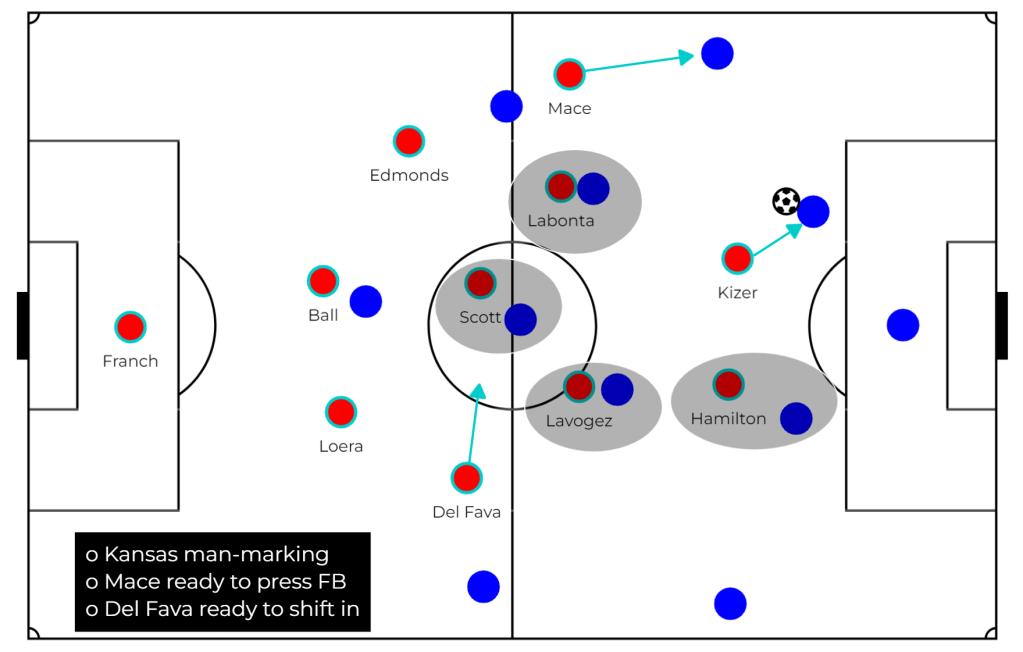
Usually the defensive shape is on paper a 3-5-2, with the wing-backs ready to press the opponent’s full-backs, tuck infield to cover with Scott (see below), or drop into a back five as appropriate. The strikers are responsible for closing down the centre-backs and goalkeeper, though their roles can change. There are games where strikers are tasked with pressing the entire opponent back four, or cutting off passes to the full-backs, while the wing-backs stay deeper. Those tactics are often used against opponents with dangerous wingers, to prevent them from getting space to run at the Kansas City back three.

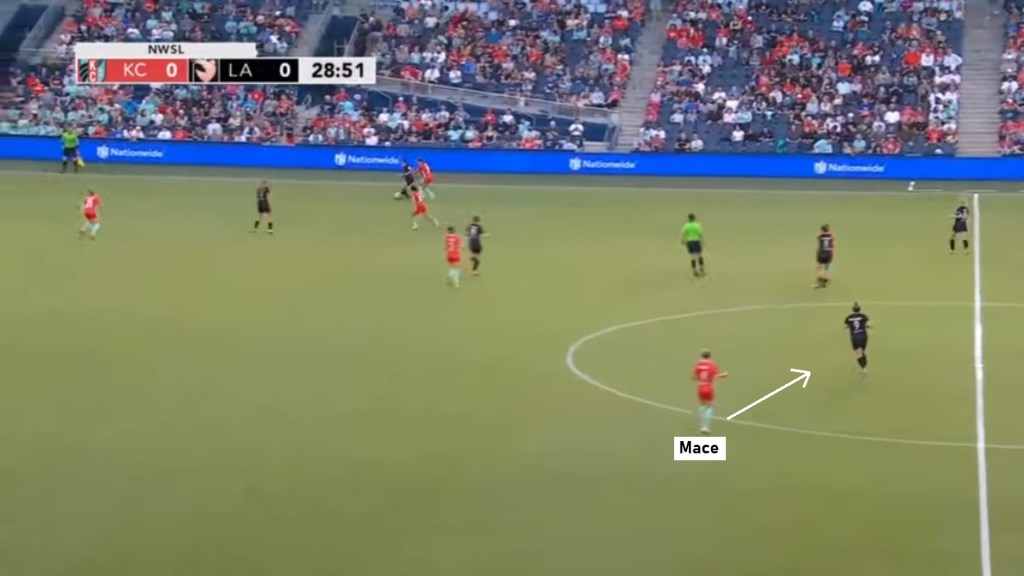
The two attacking midfielders mark the deepest opposition midfielders. Scott sweeps up behind them and looks to pick up any free player moving between the lines. This combination of midfield man-marking and pressure on the centre-backs makes it very difficult for the opponent to pass short through the middle. Consequently, they will go wide to a full-back, who will be closed down by Mace or Del Fava.
This pre-emptive marking of the opponent’s short pass options explains why KC don’t show up particularly high on PPDA or other typical metrics for pressing intensity – their defensive approach completely discourages passing out from the back altogether and forces their opponent long a lot. As a result, there aren’t so many opportunities for Kansas City to tackle, foul or steal possession high up the field.
Typical pressing metrics don’t do justice to the Current’s intensity. It’s telling that only three teams in the NWSL force their opponents into a higher Long Pass Percentage (Louisville, Washington and San Diego). Also, only four teams (the three aforementioned plus North Carolina) force their opponents into fewer passes per possession sequence (Wyscout).
Kansas City can adjust their defensive formation depending on the opponent. Sometimes they set up in a 5-4-1 with a midfield diamond. Scott is at the base, while a three-pronged attacking midfield unit (say, Lavogez-Kizer-LaBonta) shifts side-to-side in direction of the ball. The nearest attacking midfielder closes down the full-back, while the other two mark the opponent’s 6s.
Regardless of the shape, the Current’s combination of high pressure and midfield man-marking forces a lot of long balls, which feeds into the transitional nature of their games and further explains why they become so end-to-end: the opponent goes long, the ball is not under control, KC press to win it, and if they win it they counter-attack quickly. It’s helter-skelter stuff, hugely entertaining to watch (in my opinion) and also pretty effective for the most part. However, it would be wrong to ignore weaknesses in this defensive system.
The man-marking can be played through by good possession teams, like Portland, who keep the ball under pressure and work it through the gaps in midfield. When the far-side Kansas City wing-back tucks infield to help Scott, that can leave space on the flank for the opponent to switch into. In both cases, the Current’s use of three centre-backs helps reduce gaps for the opponent to break through on goal, and can at least slow the attack down. Also, Ball is diligent at tracking striker runs, and has proven tough to get past in foot races and 1-v-1s.
Finally, because Kansas City are a team that defends more player-to-player than as a unit, they can struggle if their intensity drops off. They lack the organisation of other teams at times like these, and lean heavily on Franch to command her box, claim high balls and make big reflex saves.
Creative corner kick routines
No analysis of Kansas City would be complete without discussion of their corner kicks. They mix up between going short or delivering straight into the box. They are creative with their short corner routines, though, and always looking out for ways to improve their crossing angles.
Their most common routine is for the corner taker to play a one-two with someone on the edge of the penalty box. When the corner is taken short, the opponent often pushes up to play for offside. Receiving the return pass, the corner taker drops the ball into the space between defence and goalkeeper. The ball is driven in flat so as to stop the goalkeeper from coming out and claiming it.
Another variation is to involve three players with the short corner – the taker, the receiver, and someone else running to the by-line. Opposite movements are used to try and confuse the opponent’s marking and create a better position for a cross, whether that’s with more of an angle or by working a player closer to the goal.
Also, in the recent win over Washington, they nearly scored with a clever free kick routine. Three players pretended to form a wall, with two players actually blocking off defenders and creating space for Kizer to receive to feet, turn and shoot from inside the box. It was another reminder not to switch off when KC win a set piece.
What’s next?
Kansas City Current travel to play Houston Dash in the playoff first round on 16 October. It should be an exciting game – Houston have developed a high line and offside trap since Juan Carlos Amoros took charge, and that should give openings for Kansas to attack space behind quickly, as they like to do, with Hamilton, Kizer, LaBonta etc. If the Current win, they face a difficult trip to OL Reign in the next round. Whatever happens, this has been a successful season.
At the beginning of the campaign, Kansas City were seen as unlikely to reach the postseason. That they achieved this, and finished just four points behind Shield winners OL Reign, is remarkable, especially factoring in those injuries to key players. Their results have been eye-catching, and so has their football: direct attacking, intense pressing, quick counters, creative corner routines. They have been the nicest surprise of the 2022 season, without doubt.
Discover more from Women's Soccer Report
Subscribe to get the latest posts sent to your email.
